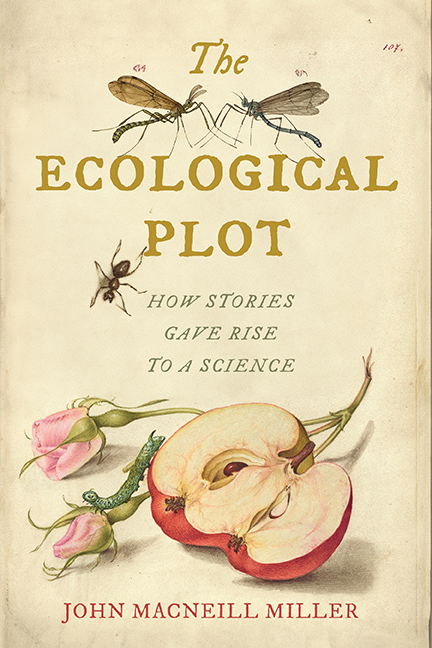
The Ecological Plot
How Stories Gave Rise to a Science
John MacNeill Miller
awards:
Sonya Rudikoff Award, (2026, Commended); Book Prize, (2025, Finalist); ASLE Book Awards, (2025, Finalist)
Unraveling the surprising history of the concept of ecology
Finalist—ASLE Ecocritical Book Award
The Ecological Plot traces the roots of this most mainstream branch of science back to an unexpected source: narrative storytelling. Weaving together the histories of different disciplines, John MacNeill Miller shows how pioneering thinkers drew on a shared set of literary techniques to imagine how different species could work together as a single, interdependent community, redefining the way we conceptualize the natural world.
Beginning with a series of revolutionary exchanges between the political economist Thomas Robert Malthus, the writer Harriet Martineau, and the naturalist Charles Darwin, The Ecological Plot identifies the foundations of modern notions of ecology, economics, and realist fiction, maps how they evolved through the works of Victorian writers such as Elizabeth Gaskell, George Eliot, and Thomas Hardy, and shows how they resurfaced in the works of Aldo Leopold and Rachel Carson a century later.
Miller’s book reveals why our most sophisticated efforts to explain humanity’s relationship to nature have been segregated into different disciplines and makes an argument for the importance of bringing these separate ways of understanding the world back together as a crucial step toward solving the environmental, economic, and ethical problems of the present.
What Miller stresses so well in The Ecological Plot is the loss of intellectual richness and possibility wrought by the siloing of sciences and the categorical separation of humanness from the rest of the living world. Since the dictates of capitalism and the survival of ecosystems are now at life-or-death loggerheads, an urgent need exists to examine that history of exclusion — and ideally, to right the wrong.- Washington Post
A strong book distinguished by the originality of its argument, the portability of its concepts and coinages, and the clarity of its writing and reasoning. The 'ecological plot' is an elegant term that should prove influential in future scholarship. If the environmental humanities are to be a truly interdisciplinary field, we need more books like this.- Elizabeth Carolyn Miller, University of California–Davis, author of Extraction Ecologies and the Literature of the Long Exhaustion
An excellent, paradigm-shifting book that upends many received truths about literature, ecology, and the relationship between them.- Jesse Oak Taylor, University of Washington, author of The Sky of Our Manufacture: The London Fog in British Fiction from Dickens to Woolf (Virginia)
A fascinating look at the role of literary storytelling in the formation of modern scientific disciplines. Miller is himself an excellent storyteller, and finds great examples from influential thinkers in these fields to guide us through the history of ecology.- David Shiffman, Arizona State University, author of Why Sharks Matter: A Deep Dive with the World's Most Misunderstood Predator
John MacNeill Miller’s The Ecological Plot presents a succinct and persuasive recharacterization of these three disciplines [ecology, economics, and literature], peeling back the artificial distinction between art and science to reveal their shared endeavor of foregrounding the interdependency of different species, modes of life, and nonliving environments through narrative storytelling.- H-Environment
As an exercise in intellectual history and literary history with an insistence on ecological plotting, narrative, and storytelling, Miller’s work undertakes a huge task and pulls it off. Ecology and economics, he demonstrates, were never separable, at least in the authors he examines. . . Miller establish[es] both synchronic and diachronic affinities across literature, natural sciences, and social sciences, all plotted meticulously here in his book. The Ecological Plot: How Stories Gave Rise to a Science is a challenging, intriguing, and essential book for people interested in the interdisciplinarity of ecological thought.- Modern Philology
- Romance, Revolution & ReformThe Ecological Plot is an inventive work of scholarship that makes a significant contribution to the field of ecocriticism through its focus on the ecologicalvalue of often-derided works of political economy. Miller’s depiction of the interconnection between nineteenth-century literary writers, economists, and naturalscientists and their importance to the development of the blueprint of ecological thinking is thoroughly convincing and invites reflection on current ecological narratives in media and literature.
- The British Society for Literature and ScienceJohn MacNeill Miller’s The Ecological Plot offers an ambitious contribution to the intellectual history of ecology by tracing the narrative forms through which ecological thinking first became imaginable.
John MacNeill Miller is Associate Professor of English at Allegheny College.

