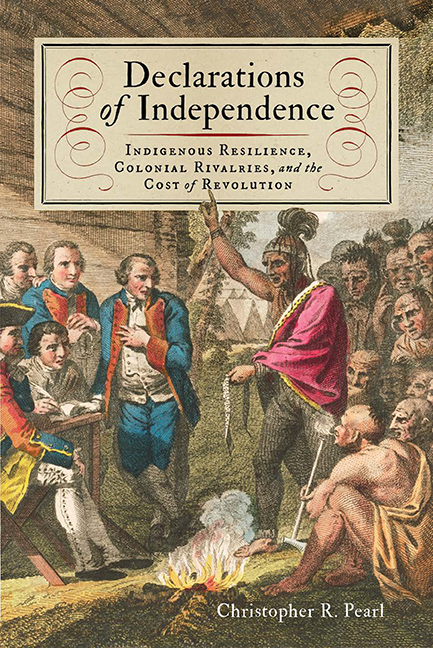
Declarations of Independence
Indigenous Resilience, Colonial Rivalries, and the Cost of Revolution
Christopher R. Pearl
Series:
subjects:
awards:
Walker Cowen Memorial Prize, (2024, Winner)
How Indigenous Americans and colonial settlers negotiated the meaning of independence in the Revolutionary era
On July 4, 1776, two hundred miles northwest of Philadelphia, on Indigenous land along the West Branch of the Susquehanna River, a group of colonial squatters declared their independence. They were not alone in their efforts. This bold symbolic gesture was just a small part of a much broader and longer struggle in the Northern Susquehanna River Valley, where diverse peoples, especially Indigenous nations, fought tenaciously to safeguard their lands, sovereignty, and survival.
This book immerses readers in that intense, decades-long struggle. By intertwining the experiences of Indigenous Americans, rebellious colonial squatters, opportunistic land speculators, and imperial government agents, Christopher Pearl reveals how conflicts within and between them all set the terms and ultimately shaped the meaning of the American Revolution. In the crucible of this conflict, memories, histories, and animosities collided and converged with tremendous consequences. Declarations of Independence delves into the racial violence over land and sovereignty that suffused the Revolutionary Age and helps restore Indigenous peoples to their central position at the founding of the United States.
An excellent, superbly written book on an incredibly important place that we know very little about. Just when you thought we knew everything about the American Revolution, along comes Chris Pearl to shed all sorts of new light.- Robert Parkinson, Binghamton University, author of Heart of American Darkness: Bewilderment and Horror on the Early Frontier
Declarations of Independence makes a significant contribution. In a wide-ranging but highly readable study, Pearl sheds new light on Pennsylvania history, the American Revolution, and Native American history. History enthusiasts and scholars alike will find much to learn in it.- Patrick Spero, Executive Officer of the American Philosophical Society, author of Frontier Rebels: The Fight for Independence in the American West, 1765-1776, Patrick Spero, Executive Director of the George Washington Presidential Library, author of Frontier Rebels: The Fight for Independence in the American West, 1765-1776
In recovering the history of the squatter republic of Fair Play, Chris Pearl illuminates not only backcountry Pennsylvania, but also the turbulence of the early American frontier. Indigenous, colonial, and imperial voices clash in this contentious and often violent tale about the contested meaning of independence in the hinterlands of the new nation.- Timothy J. Shannon, Gettysburg College, author of Iroquois Diplomacy on the Early American Frontier
- Early American LiteratureReveals the pluralization of the United States’ supposedly singular founding moment.
- North Carolina Historical ReviewAn important, multifaceted historical work. Pearl is neither dismissive of Indigenous struggles, nor scathing in his assessment of squatters’ motives for encroaching on the former’s lands. Rather, he offers a holistic understanding of human beings who found themselves in precarious situations and devised varying logics and strategies to survive.
- The New England QuarterlyBy sustaining a clear focus on the northern Susquehanna Valley, an area often overshadowed by events elsewhere, and by providing clear depictions of the region’s confusion and complexity, Declarations of Independence significantly adds to newer work. Pearl’s effort is part of the careful, responsible scholarship demonstrating that independence in revolutionary America held different meanings for different peoples, and that the 250th anniversary should be an occasion to understand the past, not simply to celebrate it.
- William and Mary QuarterlyAs Pearl tells the tale, this “long forgotten” (275) experiment in popular democracy and racial dispossession holds the key to new understandings of the American founding, in all of its violently democratic, openly imperialistic, and deeply racist dimensions.
- Pennsylvania History: A Journal of Mid-Atlantic StudiesDeclarations of Independence draws attention to a region rarely included in histories of the American Revolution.
- Journal of the Early RepublicPublished in the University of Virginia’s The Revolutionary Age series, Christopher R. Pearl’s new book frames the struggle for the Susquehanna Valley in the second half of the eighteenth century as a many-sided fight over independence. Declarations of Independence tells a multi-perspectival story, tracing the actions and motivations of many different Native and non-Native peoples with interests in the region, recognizing that differences within large categories such as Haudenosaunee, Susquehanna, and European American could be as important as those across categories.
Christopher R. Pearl is Associate Professor of History at Lycoming College and the author of Conceived in Crisis: The Revolutionary Creation of an American State.

