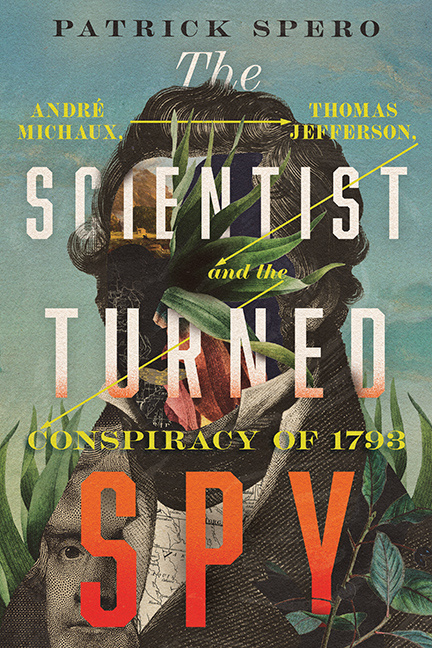
The Scientist Turned Spy
James C. Bradford Biography Prize, (2025, Winner)
The incredible story of an explorer caught up in international intrigue at the dawn of US history
André Michaux was the most accomplished scientific explorer of North America before Lewis and Clark. His work took him from the Bahamas to Hudson Bay, and it is likely that no contemporary of his had seen as much of the continent. But there is more to his story.
During his decade-long American sojourn, Michaux found himself thrust into the middle of a vast international conspiracy. In 1793, the revolutionary French government conscripted him into its service as a secret agent and tasked him with organizing American frontiersmen to attack Spanish-controlled New Orleans, seize control of Louisiana, and establish an independent republic in the American West. New evidence also strongly implicates Thomas Jefferson in this plot. Drawing on sources buried in the vault of the American Philosophical Society, Patrick Spero offers a bona fide page-turner that sheds new light on an incipient American political climate that fostered reckless diplomatic ventures under the guise of scientific exploration, revealing the air of uncertainty and opportunity that pervaded the early republic.
Well and clearly written for all types of audiences, Spero restores the undeservedly obscure Michaux to his proper place in history, immersing the reader in the eighteenth-century world of knowledge and transatlantic circulation of people, trees, plants, seeds, and ideas.- Bertrand Van Ruymbeke, University of Paris 8, author of Histoire des États-Unis. De 1492 à nos jours
In a true story that reads like a suspense thriller, Patrick Spero tells for the first time how renowned French botanist André Michaux’s 1793 scientific expedition, aided by Secretary of State Thomas Jefferson, was secretly part of startling international political intrigues, including a conspiracy to create new independent republic west of the Mississippi. A riveting narrative, reminding us that in America, dangers of conduct bordering on treason by high officials have been present from the very start.- Rogers M. Smith, University of Pennsylvania, author of That Is Not Who We Are! Populism and Peoplehood
Patrick Spero deftly narrates this surprising tale of a French botanist who became involved in political intrigue on the western frontier during the early days of the new republic. Two presidents—George Washington and Thomas Jefferson, especially the latter—are among the many notables who populate its pages. Like Spero, readers will come to appreciate not only the many botanical discoveries of André Michaux but also the labor of the enslaved workers and indigenous guides on whom he relied but rarely mentioned in his journals. A remarkable, insightful account of little-known but important events.- Mary Beth Norton, Cornell University, author of 1774: The Long Year of Revolution
Spero has produced a page-turner full of spies and intrigue that is at the same time an engaging, thought-provoking, and highly informative account of intellectual and political life in the early republic.- Cameron Strang, University of Nevada-Reno, author of Frontiers of Science: Imperialism and Natural Knowledge in the Gulf South Borderlands, 1500-1850
- William and Mary QuarterlyThe Scientist Turned Spy provides ample reason to keep the Michaux Subscription List on the APS library’s Treasures Cart. Michaux may never earn a place in the annals of spy craft, but Spero’s account of his efforts to find support for his botanizing in the postrevolutionary United States while trying to maintain his ties to a France in turmoil helps us understand what it was like for a man of science to try to work in the unsettled political climate of the last decades of the eighteenth century.
- H-Early-AmericaSpero’s work makes an important addition to the literature of natural history in the early republic. While the work of American, Spanish, and English natural historians has dominated the recent scholarship in the field, the considerable contributions of Frenchman Michaux to American botany are lesser known. This alone makes Spero’s work significant. The well-written narrative sheds more light on the Genêt controversy faced by President Washington over and above the standard narrative of the event. Jefferson’s acquiescence to the proposed Kentucky-led Louisiana plot championed by Genêt will hopefully guide more scholars to examine the intrigues in Kentucky and the Mississippi Question that caused them. The greatest contribution of Scientist Turned Spy is that the work brings early republic science and borderlands intrigue into an important conversation demonstrating that state power and knowledge production have a significant but sometimes conflicting relationship.
- American Historical Review(T)he reading experience is an enjoyable one for those who appreciate a gripping and energetic early American frontier story, told with verve and style and featuring abundant well and lesser-known historical actors. The Scientist Turned Spy may not be the last word on the American exploits André Michaux and his circle, but it certainly whets one’s appetite for more.

