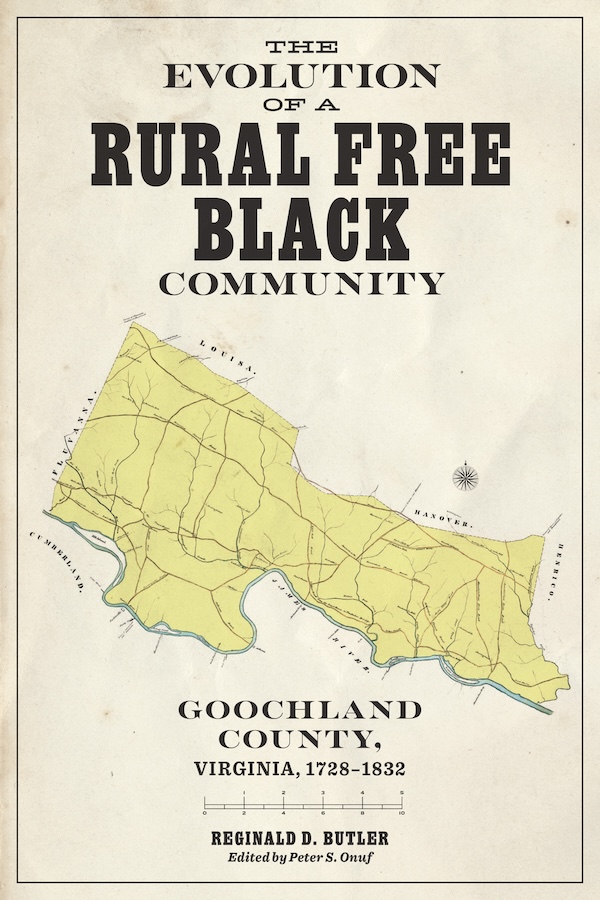
The Evolution of a Rural Free Black Community
A long-awaited work by one of the deans of Black studies
Reginald Butler, the second director of UVA’s Carter G. Woodson Institute, wrote an influential and much-cited but never published dissertation at Johns Hopkins University that focused on community formation among the free Black population of Virginia. His innovative and meticulous research in county and state archives enabled him to reconstruct the ties that bound free Black Virginians to each other and their enslaved neighbors, as well as to white employers and officials.
Butler showed that community formation emerged in response to an oppressive, often violent regime of racial domination, yet it also depended on the critical role free Black people played in the local economy and their ability to sustain reciprocally beneficial working relations with their white neighbors. By reconstructing the lived experience of free Black families and the community they created at the neighborhood level, Butler’s revelatory study offers still fresh perspectives on race and slavery in the formative decades of Virginian and American history. Now this seminal work finally sees the light of day, accompanied by several framing essays that properly situate Butler’s foundational scholarship on free Black Americans in this still-burgeoning field.
Butler’s study stands the test of time. Lively and rich in detail, it is a major contribution to the scholarship on Virginia history.- Warren Eugene Milteer Jr., George Washington University, author of Beyond Slavery’s Shadow: Free People of Color in the South
Butler's work, along with its companion essays, will be celebrated by researchers of all kinds as a great contribution to understanding a period that was foundational to subsequent centuries of race relations in Virginia, and as an example of how to use archival records to depict the nuances of people’s lives.- Sara Bon-Harper, Ph.D., Executive Director of James Monroe’s Highland, Sara Bon-Harper, Ph.D., James Monroe’s Highland
- CHOICEThis volume admirably navigates the complex historiographical issue of Free Black agency by showing how the community charted its own destiny, while also depicting how white political and social power simultaneously constrained it. Butler’s research and the accompanying essays that situate it within a broader historiographical context will be of interest to researchers and social historians.
- National Genealogical Society QuarterlyButler shows how free men and women in the antebellum Virginia Piedmont secured freedom, supported themselves, and forged community family ties. Similar local studies have multiplied in the decades since Butler's research. Continued work of this kind promises a fuller, richer picture of the free Black experience in Virginia.

