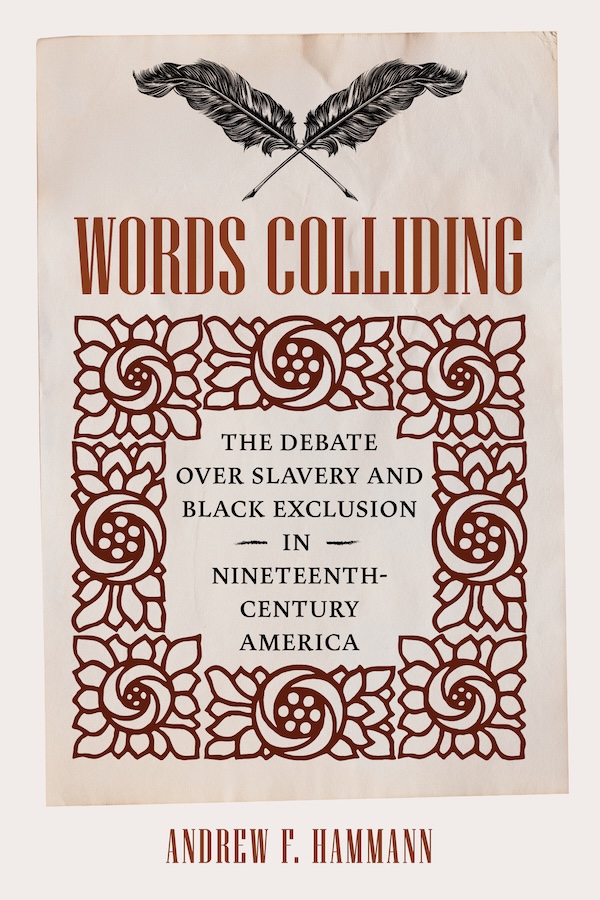
Words Colliding
The Debate over Slavery and Black Exclusion in Nineteenth-Century America
Andrew F. Hammann
The long history and lasting impact of the rhetoric of Black exclusion in American politics and culture
In 1787, Thomas Jefferson declared that the United States was destined to become a nation free of slavery—and of its entire Black population. Following his cue, Henry Clay and other prominent politicians founded the American Colonization Society in 1816, launching the Black expatriation (“colonization”) movement, a political force that, over the next eighty years, promoted the removal, with federal support, of the nation’s Black population. Throughout this time, the vast majority of Black Americans, Frederick Douglass among them, opposed this movement with great vigor and conviction, characterizing it as one of their greatest enemies, second only to slavery itself.
Words Colliding offers the fullest account to date of this political debate, highlighting its dramatic impact on the national conversations regarding slavery and Black civil rights. From the beginning, Black Americans expressed grave concern that the rhetoric of colonization framed Black freedom as a national problem. Throughout the nineteenth century, even after the Civil War and through the Jim Crow era, they argued that the colonization movement, no matter its professed aim, functioned mainly to encourage and justify racial oppression in America.
With remarkable research and bold historical imagination, Andrew Hammann has recast our understanding of a desperate debate waged across generations of American history: the place of Black Americans in the United States.- Edward L. Ayers, Bancroft Prize-winning author of American Visions: The United States, 1800-1860
- Justene Hill Edwards, University of Virginia, author of Savings and Trust: The Rise and Betrayal of the Freedman's BankAndy Hammann offers a timely and important corrective to the long history of Black exclusion, expatriation, and colonization in the United States. The history of white Americans’ efforts to control and expel people of African descent is complex, but in Hammann’s capable hands, this story is clear. Grounded in stellar research, and written with passion and clarity, Words Colliding gives voice to the Black Americans who pushed not only for the end of slavery but for their place in the body politic.
- Kirkus ReviewsA well-researched, insightful study of 19th-century racial politics . . . enthralling.
Hammann’s examination of black expatriation provides a crucial, yet overlooked, aspect of nineteenth century American political history. He has provided an indispensable view from “above”, and shows how arguments for and against expatriation fit within debates over slavery and free black Americans' quest for citizenship rights. Most importantly, Hammann pushes beyond the common use of the Civil War as an end point for the history of black expatriation, and instead provides a long-arc of this history – one that shows continuity and change within various expatriation initiatives on the federal and state level and how this ideology is central to the emergence of Jim Crow in the South by the end of the century.- Ousmane K. Power-Greene, Clark University, author of Against Wind and Tide: The African American Struggle Against the Colonization Movement
A bracing account of white Americans’ vigorous attempts to remove both enslaved- and free Black people from the United States under the banner of ‘colonization.’ Hammann’s panoramic study helps us to see the corrosive effects of removal thinking both before and after the Civil War, while establishing African American resistance as the critical factor in ensuring colonization’s defeat.- Nicholas Guyatt, Jesus College, Cambridge, author of Bind Us Apart: How Enlightened Americans Invented Racial Segregation
Meticulously researched, rigorously argued, and absolutely original.- James T. Campbell, Stanford University, author of Middle Passages: African American Journeys to Africa, 1787-2005
In Words Colliding Andrew Hammann uses the American Colonization Society and other attempts to establish African American colonies in Africa to illuminate ideas of race and nationalism that took shape in the nineteenth century and which continue to shape our culture and politics to this day. This is an original and important book.- Richard White, Stanford University, author of The Republic for Which It Stands: The United States during Reconstruction and the Gilded Age, 1865-1896
Andrew F. Hammann is a Senior Historian of the New American History initiative at the University of Richmond. He taught for several years at Stanford University, where he earned his PhD, and has been a fellow at the International Center for Jefferson Studies and at the Kinder Institute at the University of Missouri.

