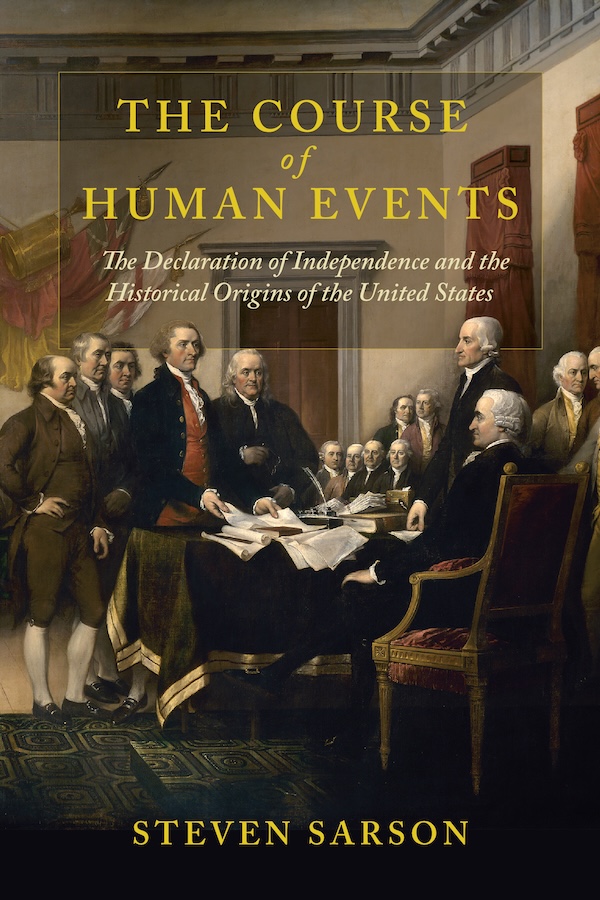
The Course of Human Events
The Declaration of Independence and the Historical Origins of the United States
Steven Sarson
Series:
awards:
Walker Cowen Memorial Prize, (2025, Winner); George Washington Prize, (2026, Finalist); Journal of the American Revolution Book of the Year Award, (2025, Finalist)
How reading the Declaration of Independence as a document of history explains its intended meaning
Thomas Jefferson chose his words carefully. Few could have been more deliberate than “When in the Course of human events,” the phrase with which he opened the Declaration of Independence. As Steven Sarson shows, the original Declaration moved through the ages of human history from Creation to American independence, assessing it according to “the Laws of Nature and of Nature’s God.”
The Declaration’s history and historical consciousness therefore help answer one of American history’s great questions: How did the founders reconcile their lofty views on equality and liberty with the inequities and iniquities that they maintained in their time? The contingencies of history and the complexities of natural law, Sarson demonstrates, meant that the Declaration’s eloquent promises of equality and liberty only applied partially to women and poor men, and not at all to Loyalists, Indigenous Americans, and enslaved people.
The Declaration’s assertion that “all men are created equal” has since become a promise of universal equality and liberty. As we reach its 250th anniversary, it is important to understand its original context as well as to continue the mission of making its promises a lived reality for all.
- David Armitage · Times Literary SupplementThe Declaration was not just part of history: it was a history. Sarson scrupulously mines its 1,300 or so words for its structuring chronicle of “an interconnected past, present, and future”. . . [he] most convincingly contends that we should take the Declaration seriously as an account of the causes of the American Revolution, as enumerated in the grievances that form the bulk of the document. This underpins his stimulating claim that his painstaking reconstruction aims not at “an original understanding of the Declaration”, but instead calls for “an understanding of the original Declaration”.
- CHOICEThis is among the best and most philosophical of several books published around the semiquincentennial of US independence and designed to explain it.
- Lindsay M. Chervinsky, Executive Director, George Washington Presidential Library, author of Making the Presidency: John Adams and the Precedents That Forged the RepublicIn The Course of Human Events, Steve Sarson returns the Declaration of Independence to its proper historical context by smartly revealing the long history of debates over rights and natural law that shaped Thomas Jefferson's prose. Sarson's deep research and thoughtful analysis help readers understand how "all men are created equal" made sense to men who lived a very different reality.
- Karin Wulf, director of the John Carter Brown Library, author of Lineage: Genealogy and the Politics of Connection in Early AmericaThe Course of Human Events introduces us to the Declaration of Independence as it was first written and understood, not as a shocking rupture with the past but as a document deeply steeped in it. This is the Declaration's historical foundations as Jefferson and his fellow revolutionaries understood them. Reclaiming the Declaration as reflective of historical thinking, Steve Sarson gives us an entirely new way of understanding why history matters--then and now.
An original take on something we thought we knew everything about. Compelling and thought-provoking. It is the first serious engagement with the Declaration’s philosophical underpinnings in several decades, reorienting readers about the Declaration's central thrust, which was to put the Revolution into the long span of human history.- Robert Parkinson, Binghamton University, author of Heart of American Darkness: Bewilderment and Horror on the Early Frontier
- Journal of the American RevolutionSarson seeks to reorient our understanding of the Declaration of Independence away from modern readings and back to the Founders’ own intentions. Although the document justified separation from Britain, Sarson explains that the Continental Congress sought to do so on the basis of well-established principles in British law and political philosophy. He outlines those ideas in a serious but readable fashion.
Steven Sarson is Professor of American Civilization at Jean Moulin University Lyon 3 and the author of British America, 1500-1800: Creating Colonies, Imagining an Empire.

