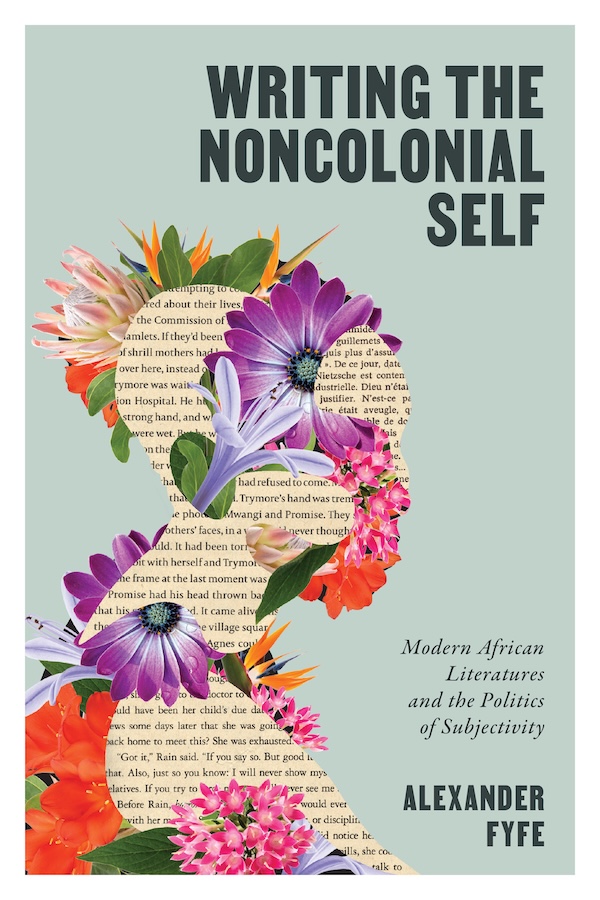
Writing the Noncolonial Self
How African literary forms imagine ways of living and being within coloniality
Writing the Noncolonial Self suggests a new way of thinking about the connections between politics, subjectivity, and literary practice. In this groundbreaking study, Alexander Fyfe reveals how African writers have used literary forms to reimagine subjectivity in new terms, a category of practices he calls the “noncolonial.” Examining the work of a diverse set of practitioners such as Bessie Head, Cheikh Hamidou Kane, and Akwaeke Emezi, Fyfe shows how African literature has taken on the challenge of rethinking the self in ways that exceed constructions of the subject, eschewing intelligibility under regimes of coloniality in favor of an investment in its own capacity to articulate alternative ways of being. Intervening in key debates in African literary studies, Writing the Noncolonial Self makes a case for the literary as an essential kind of noncolonial practice, one that at every moment rethinks its own horizons of possibility.
An accomplished and important book in the field of African — and by extension, postcolonial — literary studies that unseats all manner of sub-disciplinary truisms. Fyfe offers a series of readings that elevate structural dynamism over sociological assertion as African letters’ most resounding legacy.- Jeanne-Marie Jackson, Johns Hopkins University, author of The African Novel of Ideas: Philosophy and Individualism in the Age of Global Writing
- Grace A. Musila, University of the Witwatersrand, Johannesburg, coeditor of Rethinking Eastern African Literary and Intellectual LandscapesWriting the Noncolonial Self makes a bold step towards navigating African literary critical practice out of our imminent analytic cul-de-sac, fenced in as we are by the increasingly ineffectual claims of the ‘posts’ and the elusive aspirations of the decolonial turn.
Through a meticulous reading of selected African authors, texts and genres, Fyfe theorises what he terms the noncolonial, in reference to literary political practices that unfold within coloniality but run otherwise to its logics, while exceeding the grammars of resistance. What results is a groundbreaking book that redraws both the contours of African literary history and the genealogy of literary-critical practices that have shaped the discipline; while equipping us with a generative lens for reading texts that surpass the affordances of the ‘posts’ and prefigure the horizons of the decolonial.
Alexander Fyfe is Assistant Professor of Comparative Literature and African Studies at the University of Georgia and coeditor of African Literatures as World Literatures.

