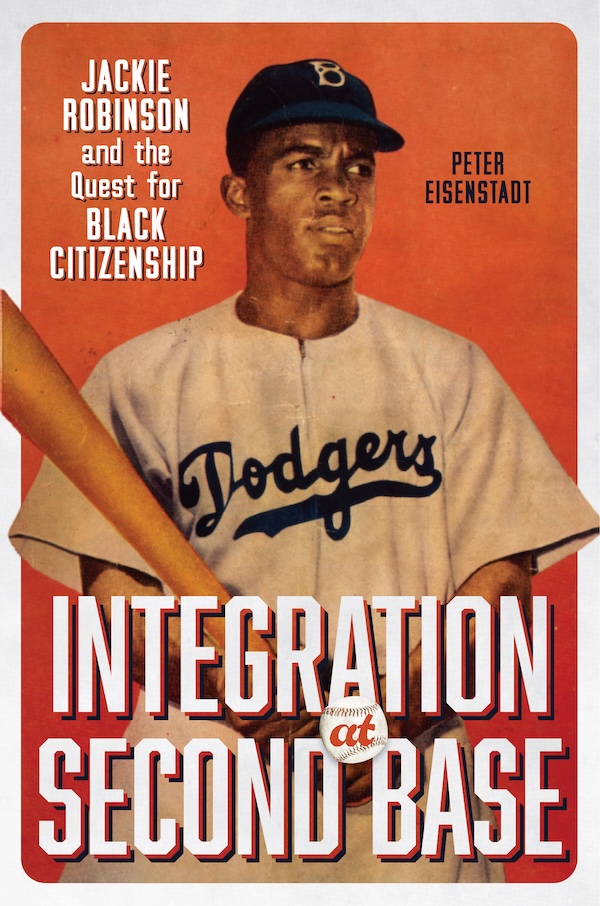
Integration at Second Base
Jackie Robinson and the Quest for Black Citizenship
Peter Eisenstadt
A new biography revealing the remarkable story of Jackie Robinson as a civil rights crusader
Jackie Robinson is one of the most enduring icons of the great American pastime—the man who broke baseball’s color line in the twentieth century, opening the door for his fellow professionals and allowing rising generations to dream of fame and glory on the diamond. But for number 42, playing for the Dodgers was just a beginning. As Peter Eisenstadt demonstrates in this compelling new biography, Robinson’s trailblazing journey was more than a role that fate thrust on him—it was politically informed and consciously connected in Robinson’s mind to a vision of integration and full Black citizenship.
When he ventured out of the Negro Leagues and into the majors, as the league’s sole Black player, his triumph could have stopped at mere tokenism. Eisenstadt reveals a more ambitious goal on Robinson’s part, as well as a side to the great sports hero we have never fully appreciated. This book explores the political and spiritual roots of Jackie Robinson’s quest for Black citizenship from his boyhood in Pasadena to his service days—during which he was court-martialed for refusing to change seats on a segregated bus—to a transcendent athletic career that included an MVP award, a World Series victory, and eventually a place in the Hall of Fame. In his life after baseball, Robinson went on to serve as a civil rights leader, columnist, and political advocate.
The determination that spurred his great achievements was always accompanied by an understanding of just how far society still needed to go: despite his success, at the end of his life he was convinced that he “never had it made.” In telling the story of Robinson’s remarkable life, this book sheds invaluable light on the complex meanings of integration.
- Morgan Campbell, author of My Fighting Family: Borders and Bloodlines and the Battles That Made UsEisenstadt doesn't just separate fact from fable in tracing Robinson's path to the Brooklyn Dodgers. He places Robinson's career trajectory squarely within a long-running, often heated debate among African American leaders and intellectuals about the form, function, and cost of wholesale racial integration — crucial context for understanding exactly what Robinson achieved when he shattered Major League Baseball's color barrier.
- Wall Street JournalEisenstadt offers a look at baseball’s color line, postwar America and a gifted athlete who evolved into a businessman, an advocate for black civil rights and an opponent of all forms of discrimination . . . [Eisenstadt] argues that Robinson pioneered the role of the former athlete who uses his celebrity to advance political causes, in his case “the realization of full and effective citizenship." . . . This American hero understood that his personal success was no substitute for broad equality and achievement.
- Chris Lamb, author of From Jack Johnson to LeBron James: Sports, Media, and the Color LineIn Peter Eisenstadt's compelling biography on Jackie Robinson, the ballplayer sought something more elusive than racial equality in baseball. Eisenstadt’s Robinson wanted full citizenship for Black Americans—that is, that Blacks have the same opportunities to achieve their aspirations as other Americans. Integration at Second Base captures Robinson’s frustrations and his tortured psyche. Sadly, Robinson’s vision of full citizenship for Black Americans is perhaps as elusive now as it was when he died more than a half-century ago.
- Larry Lester, Negro league baseball historian and authorWhen a player reaches second base, he's considered to be in scoring position—just one smart move away from home. In Eisenstadt’s chronicle, Jackie Robinson is portrayed as navigating a far more complex diamond: striving to ‘score’ citizenship rights and deliver a winning strategy for social reparation and equal justice for non-white athletes. Trace Robinson’s turbulent journey from boyhood through military service, professional sports, and into the arenas of politics and corporate leadership—a path marked by resilience, confrontation, and transformation.
- Marvin T. Chiles, Old Dominion University, author of The Struggle for Change: Race and the Politics of Reconciliation in Modern RichmondThis book propels sports beyond the field of play and into the realm of socio-politics.
Peter Eisenstadt is Affiliate Professor of History at Clemson University and the author of Against the Hounds of Hell: A Life of Howard Thurman.

