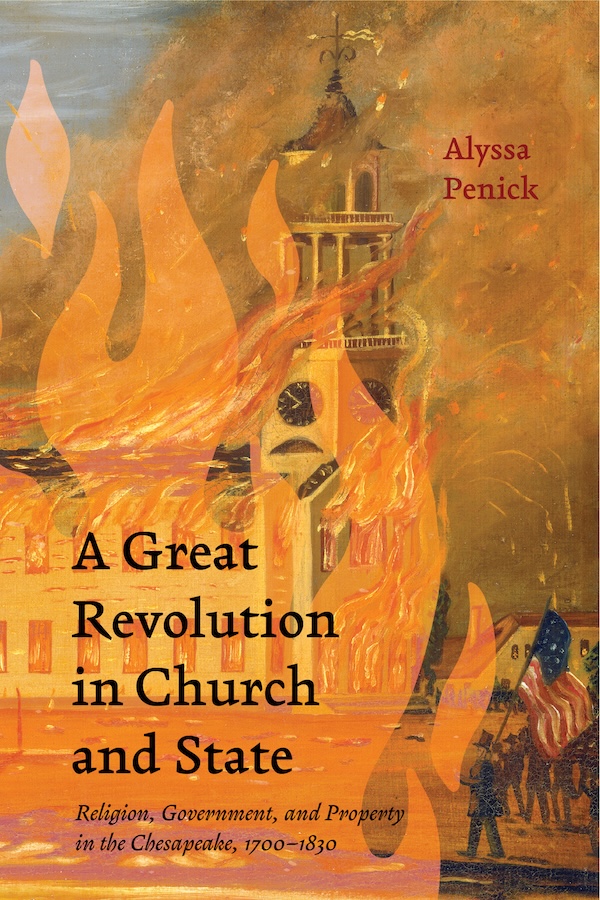
A Great Revolution in Church and State
The untold story of how church and state were remade in Revolutionary America
A Great Revolution in Church and State rewrites the history of American religious freedom in the founding era. In colonial Virginia and Maryland, the established Church of England was a powerful arm of royal authority that enforced the law, collected taxes, amassed considerable wealth, and enslaved men, women, and children. During the American Revolution, reformers began demolishing this regime without a blueprint for replacing it. Because the Anglican establishment had rested on property, legal privilege, and racial slavery, dismantling it became a material struggle as much as an ideological one. While both Maryland and Virginia claimed to have established religious freedom, the two states adopted radically different policies in practice — forging incompatible definitions of what an "establishment of religion" meant just as the First Amendment was being ratified.
Alyssa Penick ultimately shows that disestablishment was neither a foreordained separation of church and state nor a clear-cut triumph of liberty but a fraught, improvised contest over power and property. Americans expanded rights of conscience and replaced orthodoxy with popular sovereignty even while entrenching racial slavery and consolidating state power, marrying the Revolution's most conservative commitments to its most radical promises.
- Katherine Carté, Southern Methodist University, author of Religion and the American Revolution: An Imperial HistoryPenick skillfully interrogates the relationship between church and state not as abstractions—the concepts of religion and government about which Enlightenment-era theorists like Madison and Jefferson spilled so much ink—but rather as church and state actually existed, intertwined local institutions with substantial responsibilities that were embedded in local communities. Her book, with its careful attention to the dynamics of slavery, connects the material culture of religion to the Chesapeake’s most important material (and economic) reality, its dependence on slavery as both a system of labor and a system of organizing and moving capital.
- Mary Sarah Bilder, Boston College Law School, author of Female Genius: Eliza Harriot and George Washington at the Dawn of the ConstitutionPenick’s fascinating account deftly argues that the practical realities of tearing down the parish created the shape of establishment of religion and free exercise. As property and enslaved people were fought over, religious societies and the state divided the parish’s power over civic life. A wonderful and illuminating history.
Alyssa Penick holds a Ph.D. in History from the University of Michigan and was a Senior Fellow at the Jefferson Scholars Foundation at the University of Virginia. She is currently a J.D. Candidate at Yale Law School.

