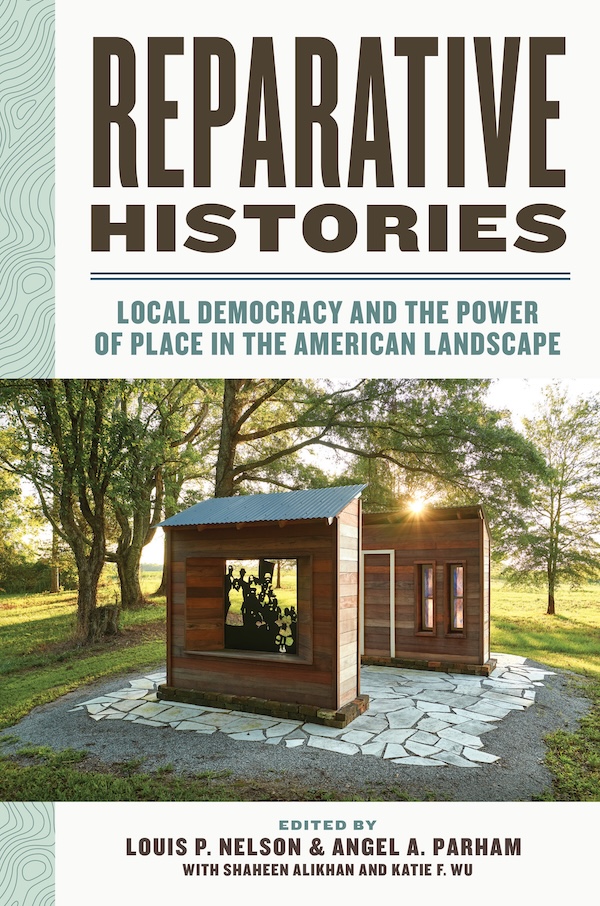
Reparative Histories
How historic sites can foster community dialogue about who we have been, who we are now, and who we wish to be
In a moment shaped by alarming levels of national polarization and disembodied lives spent increasingly online, this book argues that historic sites—courthouses, churches, walking trails, house museums, local monuments—are the best public resource available for spurring productive dialogue about the American past, present, and future. This volume’s wide-ranging essays—surveying a variety of local historical sites across the nation, from James Madison’s plantation at Montpelier to the former Japanese internment camp Manzanar—are complemented by discussions with directors and curators doing critical preservation and interpretive work on the ground today. They call those who care about healthy democracy and civic engagement to the work at hand. Historic sites, as the contributors to this collection show, are ideal venues for conversations about shared principles, our national successes and failures, and the importance of the local to binding together the nation.
- Lisa Goff, University of Virginia, author of Shantytown, U.S.A.: Forgotten Landscapes of the Working PoorA lively and readable collection that will be of considerable interest to public history practitioners; scholars of architectural history, historic preservation, and memory; and local civic and political leaders. Curating reparative histories that foreground racial justice is both urgent and necessary, and the contributors bring a remarkable range of expertise and insight to that task. The book stands out for its clarity, depth, and breadth.
Louis P. Nelson is Vice Provost for Academic Outreach and Professor of Architectural History at the University of Virginia and the coeditor of Educated in Tyranny: Slavery at Thomas Jefferson’s University. Angel A. Parham is Associate Professor of Sociology at the University of Virginia and the author of American Routes: Racial Palimpsests and the Transformation of Race. Shaheen Alikhan is a PhD student in Architectural History and Katie F. G. Wu is a PhD student in History, both at the University of Virginia.
Acknowledgments
An Introduction | Louis P. Nelson and Angel A. Parham
Part I: Minority Leadership
I_1 McLeod Plantation Historic Site: Centering the Voices of the Enslaved | Toby Smith
I_2 Conversation with Estevan Rael Galvez on Native Bound/Unbound
I_3 Who Speaks for the Enslaved?: The Road to Structural Parity at James Madison’s Montpelier | Elizabeth V. Chew
I_4 Conversation with Amy Uyeki, Sheri Woo, and Vicki Ozaki on Humboldt Asians and Pacific Islanders in Solidarity
Part II: Programming for Repair
II_1 Remembering Japanese American Mass Incarceration at Manzanar’s National Historic Site | Alice Yang
II_2 Historical Interpretation as Repair Work: A Case Study in Process | Elijah Gaddis
II_3 Conversation with Joseph Dunn on Laura Plantation
II_4 Conversation with Paul and Mary Liz Stewart on Underground Railroad Education Center
Part III: Artistic Interventions
III_1 Stewards of a Stage: Place-Based Repair in Boston’s Council Chamber | Katie F. Wu
III_2 Public Art and Placemaking in Charlottesville | Louis P. Nelson
Part IV: Community History
IV_1 Writing Histories of Everyday Places: Two Neighborhoods, Two Gardens | Arijit Sen
IV_2 Conversation with Gia Hamilton on New Orleans African American Museum
IV_3 Conversation with Stacie Marshall and Pastor Melvin Mosley and Ms. Betty Mosley on Hesters Heritage Foundation
Part V: Rendering Visible
V_1 Charleston, South Carolina, in the Years 1783–1787 | Shaheen Alikhan
V_2 Conversation with Carol Bebelle on Maafa in New Orleans
V_3 Conversation with JerriAnne Boggis on Black Heritage Trail in New Hampshire
Part VI: Preparing Public Historians
VI_1 I It’s How You Say It: Training Towards Empathic Interpretation in Divisive Times | Brandon Michael Dillard
VI_2 This Place Bus Tells a Story | Robert Louis Brandon Edwards
VI_3 Conversation with Brianna Baker, Aleah Parsons, Marcus Smith, and Ebram Victoria on Black Life in Bellevue
Part VII: Institutional Partnerships
VII_1 A Community of Friends: The Priority of Partnerships in the National Memorial to the Underground Railroad | Gregory Thompson
VII_2 The Spirit of Hester—An Acknowledgement: Academic Community Engagement for Reconciliation | Brian C. Campbell
VII_3 Displays of Sovereignty: Interpretation at Cherokee Nation Museums | Karen Shade-Lanier
Part VIII: International Implications
VIII_1 Heritage and the Public Country House in the UK | Oliver Cox and Tarnya Cooper
VIII_2 The Ancestral Call for Return—Start here. End (t)here—Part II: The Path to Repair | Tara A. Inniss
Notes on Contributors
Index

