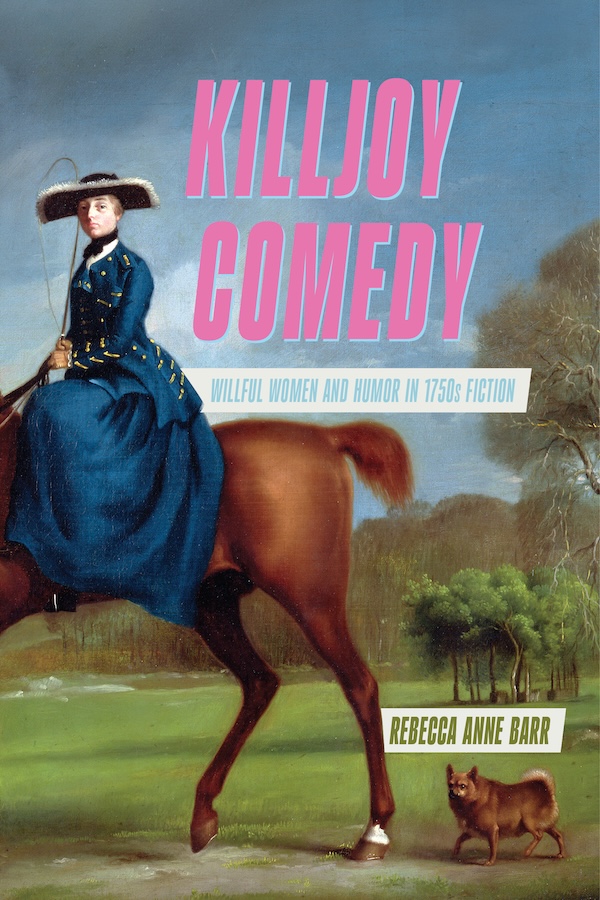
Killjoy Comedy
Tracing the eighteenth-century literary origins of the “feminist killjoy” archetype
In this provocative literary history, Rebecca Anne Barr reveals how the high-minded heroine of Samuel Richardson’s tragic Clarissa provided a lasting template for female humorlessness in service of morality. Killjoy Comedy traces Clarissa’s influence in a series of intelligent, moral and thoroughly obstinate female protagonists whose unhappiness fueled both cultural critique and comic misfires in 1750s fiction. Even as women writers recognized difficulty as a source of empowerment, they refused to wholly abandon their sense of humor, creating experimental fictions that mixed wit and morality, seriousness and mirth.
Killjoy Comedy exposes how the cultural potency, negative energy, and performative politics of the female scold were established in the mid-eighteenth century novel and influenced the dissident heroines of Mary Wollstonecraft, Austen’s Mansfield Park, and Brontë’s Jane Eyre, and left a legacy that can still be felt today. Barr not only challenges our perception of gender, genre, and humor in 1750s fiction, she also provides an arresting comparison with the cultural politics of the present.
- Stephanie Hershinow, Baruch College, CUNY, author of Born Yesterday: Inexperience and the Early Realist NovelThis book is a romp. I thoroughly enjoyed reading it, and I welcome its irreverent approach to eighteenth-century studies. Killjoy Comedy is poised as a provocation, but its claims about gender, genre, and humor are grounded in close and careful attention to literary texts. This is a fun book with a serious payoff.
- Christina Lupton, Rutgers University, author of Love and the Novel: Life After ReadingAn original recasting of a group of eighteenth-century novels, analyzed in light of their politically conservative but tensely felt humor. Barr’s argument is convincing and convincingly made, and written with a real bounce and wit of its own.
Rebecca Anne Barr is Associate Professor in the Faculty of English, University of Cambridge, and Deputy Director of the Centre for Research in Arts, Social Sciences, and the Humanities.

