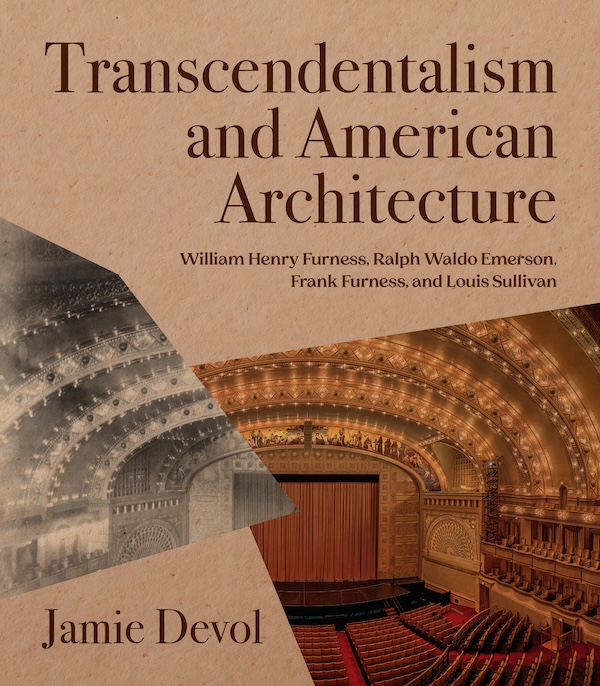
Transcendentalism and American Architecture
An intellectual lineage from New England Transcendentalism to the architectural “street poetry” of Philadelphia and Chicago
This groundbreaking study explores how the architectural ethos of Louis Sullivan originated in American Transcendentalism, a legacy brought about, in large measure, by the father-and-son duo of William Henry and Frank Furness. Jamie Devol shows how the intellectual and aesthetic ideals articulated by the Reverend William Henry Furness and his lifelong friend Ralph Waldo Emerson helped shape the thinking of Furness’s architect son, Frank Furness. This influence extended directly to Frank’s protégé, Louis Sullivan, who had already begun cultivating a Transcendentalist sensibility during his New England youth.
Through an in-depth look at the Reverend Furness’s writings, oratory, and abolitionism, a fresh examination of Frank Furness’s buildings, and a sympathetic reassessment of Sullivan’s writings and architecture, this book argues that Transcendentalism was the wellspring of nearly all they created, uniting works, both written and built, that spanned half a continent and a century of progress. This narrative, which brings William Henry Furness to the fore as a significant Transcendentalist, offers new defining insights into the history of modern American architecture, definitively separating Sullivan’s legacy from the later International Style.
- Peter Wirzbicki, Princeton University, author of Fighting for the Higher Law: Black and White Transcendentalists Against SlaveryThe first book to demonstrate how Transcendentalism shaped the (literally) concrete history of American architecture. Devol helps us to recontextualize Louis Sullivan’s famous motto that 'form follows function,' and demonstrates how he inherited a conception of aesthetics from Coleridge, Emerson, and Furness that imagined buildings as organic wholes, whose function would be wrapped up in the aesthetic and spiritual effect that the building had on people.
- Joseph Siry, Professor of Modern Architectural History, Wesleyan University, and author of The Chicago Auditorium Building: Adler and Sullivan's Architecture and the City, Joseph Siry, Wesleyan University, author of The Chicago Auditorium Building: Adler and Sullivan's Architecture and the CityThe most thorough exploration to date in the literature on Frank Furness and Louis Sullivan to interpret their architecture (and, more in Sullivan’s case, their writings) as expressions of Transcendentalism, whose roots extend to both European Romanticism (Goethe, Coleridge, and others) and New England Unitarianism (Channing) and which linked to Furness through his father’s lifelong friendship with Ralph Waldo Emerson. The author succeeds in tracing this long arc of ideas from literature and theology to architecture. There is no book which so holistically and consistently works with this concept for both these architects.
Jamie Devol is a registered architect, artist, and independent scholar living in Massachusetts.

