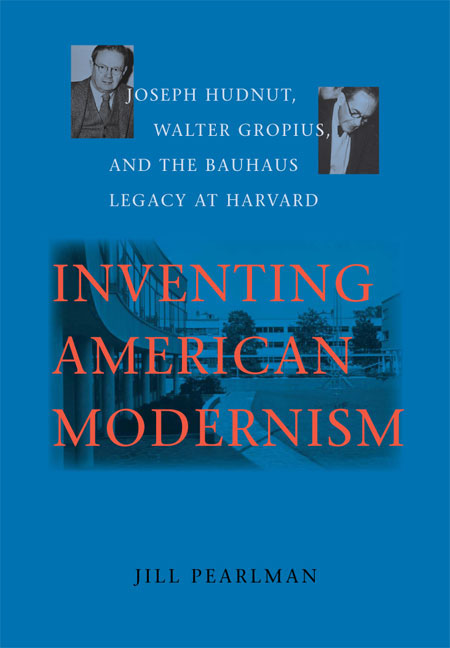
Inventing American Modernism
From the late 1930s to the early 1950s, the Harvard Graduate School of Design played a crucial role in shaping a new modern architecture and the modern city. Architects, planners, teachers, and students from all over the world looked to the new GSD, with its celebrated faculty and curriculum, for the path to modern design. While the school’s significance is widely recognized by architectural historians, most studies have concentrated on the Bauhaus founder Walter Gropius and his transformation of Harvard's old Beaux-Arts School of Architecture into a "Harvard-Bauhaus," a radically new school with a single outlook. In Inventing American Modernism, Jill Pearlman argues that Gropius did not effect these changes alone and, further, that the GSD was not merely an offshoot of the Bauhaus. She offers a crucial missing piece to the story--and to the history of modern architecture--by focusing on Joseph Hudnut, the school’s dean and founder.
After heading the architecture school at the University of Virginia, and then at Columbia University, Hudnut created the GSD at Harvard in 1936, before Gropius was appointed, and he headed the school until 1953, the year after Gropius resigned. From the beginning, Hudnut gave the GSD its modern pedagogical direction, and he continued to oversee its curriculum and staffing for the next seventeen years. Although originally an admirer of Gropius's work and theories, Hudnut came to clash with him over the control of the direction of modern architecture and planning in the United States Gropius won the battle, but Pearlman shows that, had the GSD followed the path Hudnut wanted, modern architecture and the modern city might well have been different.
In his role as public intellectual, Hudnut wielded an influence that reached outside the university, distinguished by his encouraging people to participate in the architectural and urbanistic matters that affected their lives. A story involving European modernists such as Marcel Breuer, Martin Wagner, and Christopher Tunnard, as well as a number of other architects, city planners, and landscape architects, this book is more than the study of a single school; it is a look at the origins of modernism at a defining moment in the history of twentieth-century architecture.
Published in association with the Center for American Places
- Peter G. Rowe, Raymond Garbe Professor of Architecture and Urban Design and former Dean of the Faculty of Design, Harvard University"Jill Pearlman’s book is a very well researched and enthralling account of interactions and, indeed, clashes between two individuals who shaped modern architectural education at Harvard and beyond. It not only returns Hudnut, deservedly, nearer to center stage, but fills in numerous gaps and sheds light on important episodes in the Graduate School of Design’s rise to prominence, that have gone unnoticed. From a contemporary insider’s perspective, Pearlman’s central arguments are compelling. They answer questions that many of us have wondered about.
- Architectural ReviewPearson's book is excellent history, deeply researched, rarely mistaken and always pointed. The index is a model of excellence.
- Architectural RecordPearlman recounts in detail the power struggles, personality clashes, and shifting alliances that occurred--both within and outside the GSD--as the drama of Modern architecture and planning unfolded in America. Such intricacies are fascinating for fans of the Modern movement, who know, of course, that 'God is in the details.'
- Journal of the Society of Architectural Historians[A] convincing and important contribution to the trajectory of mid-twentieth-century modernist scholarship. What emerges throughout is a sense of real people engaged in real power struggles over serious concerns, with buildings as major performers. Pearlman . . . has advanced our understanding of postwar architectural culture.
Jill Pearlman teaches the history of architecture and urbanism at Bowdoin College.

