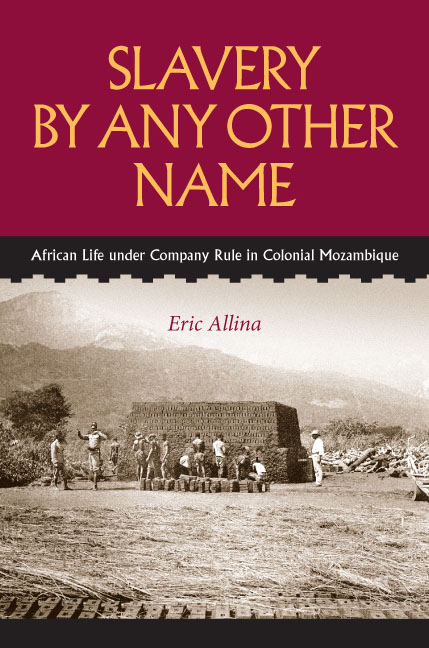
Slavery by Any Other Name
Joel Gregory Prize - United States, (2012)
Based on documents from a long-lost and unexplored colonial archive, Slavery by Any Other Name tells the story of how Portugal privatized part of its empire to the Mozambique Company. In the late nineteenth and twentieth centuries, the company governed central Mozambique under a royal charter and built a vast forced labor regime camouflaged by the rhetoric of the civilizing mission.
Oral testimonies from more than one hundred Mozambican elders provide a vital counterpoint to the perspectives of colonial officials detailed in the archival records of the Mozambique Company. Putting elders' voices into dialogue with officials' reports, Eric Allina reconstructs this modern form of slavery, explains the impact this coercive labor system had on Africans’ lives, and describes strategies they used to mitigate or deflect its burdens. In analyzing Africans’ responses to colonial oppression, Allina documents how some Africans succeeded in recovering degrees of sovereignty, not through resistance, but by placing increasing burdens on fellow Africans—a dynamic that paralleled developments throughout much of the continent.
This volume also traces the international debate on slavery, labor, and colonialism that ebbed and flowed during the first several decades of the twentieth century, exploring a conversation that extended from the backwoods of the Mozambique-Zimbabwe borderlands to ministerial offices in Lisbon and London. Slavery by Any Other Name situates this history of forced labor in colonial Africa within the broader and deeper history of empire, slavery, and abolition, showing how colonial rule in Africa simultaneously continued and transformed past forms of bondage.
- Frederick Cooper, New York UniversityThe depth of analysis of on-the-ground practices of labor coercion in Slavery by Any Other Name is a major contribution, and the picture one gets of the positions of Portuguese administrators and African chiefs, caught in the middle of an iniquitous system, is illuminating. The archival evidence deployed here is likewise impressive.
- The International Journal of African Historical StudiesAllina provides a meticulously researched labor history, but what he provides is much more interesting than a laundry list of labor abuses under Portuguese rule. Rather, he tells a nuanced history of the region, and how Africans responded to and engaged with Company and colonial rule.
- KronosProvides fascinating insights into the minds of colonial administrators.... A poignant and detailed description of the horrors of colonial labour practices in Mozambique.... [Allina] succeeds in revealing the mechanisms through which Africans resisted the tentacles of the chartered company through open and negotiated means.
- The Journal of Modern HistoryEric Allina has written a compelling account of African life under the forced labor regimen of the Portuguese in Colonial Mozambique. His study illuminates how the prolonged exploitation of Africans residing in territory leased by royal charter or the Mozambique Company led to widespread rural impoverishment that continues to plague the region today. By plumbing the long-lost records of the Mozambique Company and combining this wealth of archival data with evidence gathered from oral testimonies of Mozambican elders, Allina refutes the rhetoric of empire couched in Portuguese claims to be engaged in a civilizing mission.
- African AffairsAn important book on the social history of colonial Africa.... Allina succeeds admirably in describing the appalling history of a specific Anglo-Portuguese cooperation.
- The American Historical ReviewSlavery by Any Other Name makes a valuable contribution to our knowledge of concessionary companies and their reliance on bound labor in Mozambique
- The HistorianSlavery by Any Other Name brings an important archive to wider notice.
- International Labor and Working-Class History...add[s] depth and complexity to our knowledge of labor in early colonial Africa.... Allina is very perceptive on the gender and intergenerational dynamics of forced labor.
Eric Allina is Associate Professor of History at the University of Ottawa.
Introduction
1. Ending Slavery and Creating Empire in Africa: From the "Indelible Stain" to the "Light of Civilization"
2. From Law to Practice: "Certain Excesses of Severity"
3. The Critiques and Defenses of Modern Slavery: From Without and Within, Above and Below
4. Mobility and Tactical Flight: Of Workers, Chiefs, and Villages
5. Targeting Chiefs:: From "Fictitious Obedience" to "Extraordinary Political Disorder"
6. Seniority and Subordination: Disciplining Youth and Controlling Women’s Labor
7. An "Absolute Freedom" Circumscribed and Circumvented: "Employers Chosen of Their Own Free Will"
8. Upward Mobility: "Improvement of One’s Social Condition"
Conclusion: Forced Labor’s Legacy
Notes
Bibliography
Index

