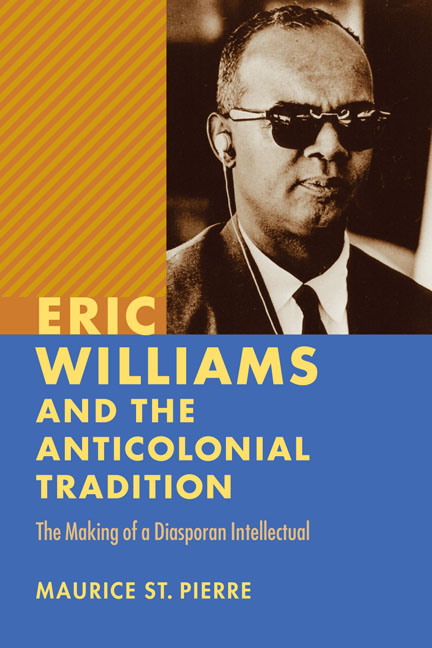
Eric Williams and the Anticolonial Tradition
A leader in the social movement that achieved Trinidad and Tobago’s independence from Britain in 1962, Eric Williams (1911–1981) served as its first prime minister. Although much has been written about Williams as a historian and a politician, Maurice St. Pierre is the first to offer a full-length treatment of him as an intellectual. St. Pierre focuses on Williams's role not only in challenging the colonial exploitation of Trinbagonians but also in seeking to educate and mobilize them in an effort to generate a collective identity in the struggle for independence. Drawing on extensive archival research and using a conflated theoretical framework, the author offers a portrait of Williams that shows how his experiences in Trinidad, England, and America radicalized him and how his relationships with other Caribbean intellectuals—along with Aimé Césaire in Martinique, Juan Bosch in the Dominican Republic, George Lamming of Barbados, and Frantz Fanon from Martinique—enabled him to seize opportunities for social change and make a significant contribution to Caribbean epistemology.
- Rupert Lewis, University of the West Indies, Mona, author of Walter Rodney’s Intellectual and Political ThoughtThis book is a breakthrough in reframing the way Eric Williams has been written about. Maurice St. Pierre has brilliantly theorized the intellectual and cultural origins of one of the Caribbean’s leading scholar-politicians.
- American Historical ReviewIn this important book, Maurice St. Pierre reconstructs [Eric Williams’s] path from the academic to the politician. He examines the origins and development of ideas and the production and dissemination of knowledge that helped transform Williams to the leader of a social movement.... This is a stimulating book and a major contribution.
- Bridget Brereton · Caribbean QuarterlySt Pierre’s book is well researched and interesting, and his use of the records in the US National Archives is especially valuable.
- SX SalonThe Caribbean has produced many fine intellectuals who have earned international recognition. Within the region however, a number of these scholars have entered public life taking on the role of national leader: Eric Williams is one example.... St. Pierre’s book offers the reader a glimpse of some of the possible factors that contributed to Williams’s intellectual grounding and how his public discourses helped redefine this Trinbagonian academic as a scholar who could move effortlessly from Oxford University to the University of Woodford Square.
Maurice St. Pierre, author of Anatomy of Resistance: Anti-Colonialism in Guyana, 1823–1966, is Professor Emeritus of Sociology and Anthropology at Morgan State University.

