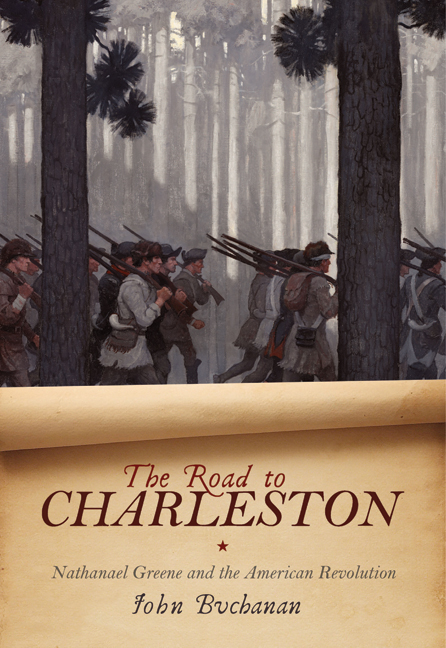
The Road to Charleston
Fraunces Tavern Museum Book Award - Honorable Mention - United States, (2020); American Revolution Round Table of New York City Best Book Prize - United States, (2020); Society of the Cincinnati Book Prize - United States, (2019); Society of the Cincinnati Book Prize, (2019, Winner); Best Book Prize, (2020, Winner); Book Award, (2020, Commended)
In The Road to Guilford Courthouse, one of the most acclaimed military histories of the Revolutionary War ever written, John Buchanan explored the first half of the critical Southern Campaign and introduced readers to its brilliant architect, Major General Nathanael Greene. In this long-awaited sequel, Buchanan brings this story to its dramatic conclusion.
Greene’s Southern Campaign was the most difficult of the war. With a supply line stretching hundreds of miles northward, it revealed much about the crucial military art of provision and transport. Insufficient manpower a constant problem, Greene attempted to incorporate black regiments into his army, a plan angrily rejected by the South Carolina legislature. A bloody civil war between Rebels and Tories was wreaking havoc on the South at the time, forcing Greene to address vigilante terror and restore civilian government. As his correspondence with Thomas Jefferson during the campaign shows, Greene was also bedeviled by the conflict between war and the rights of the people, and the question of how to set constraints under which a free society wages war.
Joining Greene is an unforgettable cast of characters—men of strong and, at times, antagonistic personalities—all of whom are vividly portrayed. We also follow the fate of Greene’s tenacious foe, Lieutenant Colonel Francis, Lord Rawdon. By the time the British evacuate Charleston—and Greene and his ragged, malaria-stricken, faithful Continental Army enter the city in triumph—the reader has witnessed in telling detail one of the most punishing campaigns of the Revolution, culminating in one of its greatest victories.
- Library JournalUsing primary sources along with historian analysis, Buchanan presents a lively chronicle of the arduous fight of the Americans to reclaim Georgia and the Carolinas…. With a colorful cast of characters...[t]his engaging read for military and American history enthusiasts provides an in-depth review and argument for the criticality of Greene’s contribution to American Independence.
- Mark Edward Lender, Kean University, coauthor of Fatal Sunday: George Washington, the Monmouth Campaign, and the Politics of Battle"Outstanding—easily the best in the literature on the subject. Buchanan argues persuasively that human agency is as vital a factor in war as chance, and that Greene’s decisions, both good and bad, were critical in the eventual American success in the southern theater. His book is military history at its best."
- John Oller, author of The Swamp Fox: How Francis Marion Saved the American Revolution and American Queen: The Rise and Fall of Kate Chase Sprague--Civil War "Belle of the North" and Gilded Age Woman of ScandalWritten in the same lively, engaging style as his prior "Road to" books on the American Revolution, Jack Buchanan's The Road to Charleston will likewise become essential reading for anyone interested in the Revolution's Southern Campaign. The author does not shy from taking an opinionated stand (always well supported) on controversial or long disputed issues, such as the Waxhaws massacre, the Siege of Ninety Six, and--in a particularly masterful chapter--the Battle of Eutaw Springs, the most important of Nathanael Greene's South Carolina engagements. What emerges is a vivid portrait of Greene--"a great and good man" who, through genius and persistence, drove the British from Charleston.
- James Kirby Martin, University of Houston, author of Benedict Arnold, Revolutionary Hero: An American Warrior ReconsideredThe Road to Charleston stands as an imposing sequel to Buchanan's classic earlier works on the American Revolutionary War. This authoritative and engaging volume represents a magisterial study. Must read history at its very best.
- Wall Street JournalThe story of Yorktown and of Lord Cornwallis’s surrender there in October 1781 is one that most of us know.... The part of the story many Americans don’t know is that the Revolutionary War dragged on for another year and three months, more or less, with a lot more fighting in the South, where the British continued to do battle in the hope that Americans who remained loyal to the crown would join them in putting down the rebellion..... John Buchanan chronicles this post-Yorktown period of the war in The Road to Charleston: Nathanael Greene and the American Revolution, and it is a chilling tale.
- Journal of the American Revolution[A] thoughtful and reasoned approach essential to producing quality historical scholarship.... Readers will not be disappointed with this book. In both style and substance, John Buchanan produced a wonderfully written account of the Southern theater worthy of the discriminating reader.
- CHOICEBuchanan’s tone of familiarity and interpretive commentary on the events and historical personages involved reveal his erudition and thoughtful reflections on the many primary sources used.... This is a readable scholarly narrative history, including portraits and maps, likely to arouse the interest of students and general readers.
- American History MagazinePack such information into a book combining good writing with good research and that volume's appeal is magnetic. The Road to Charleston is such a book.
- The Journal of Military HistoryThe Road to Charleston is wide-ranging, persuasive, and clever. Academic historians will... appreciate this updated treatment of the Continental Army's final major campaign. Popular audiences will also learn much from his sophisticated history.
- MuzzleloaderThe final stages of the Revolutionary War in the southern states has been a rather neglected topic, and the author is well qualified to pen this volume. A knowledgeable historian, thorough researcher, and lively writer, Buchanan has written what is likely to remain the authoritative account of the topic. Readers will discover a captivating tale as they follow the heroic struggle for liberty on The Road to Charleston.
- Journal of Southern HistoryThe writing style is engaging, offering vivid descriptions of the key military and political figures of the southern campaign.... For those interested in military history, and particularly the war in South Carolina, this book offers an excellent resource.
- American Spirit MagazineBuchanan's The Road to Charleston is a military history of those grim years and of General Nathanael Greene's ultimate victory there. In this narrative, Buchanan makes a solid case for Greene (August 7, 1742-June 19, 1786) as an indispensable aid to victory in the South.... [An] absorbing account.
John Buchanan, former chief registrar of the Metropolitan Museum of Art, is the author of The Road to Valley Forge: How Washington Built the Army that Won the Revolution and The Road to Guilford Courthouse: The American Revolution in the Carolinas.
Acknowledgments
Chronology
Prologue
1. "We March Tomorrow Directly for South Carolina"
2. "We Must Endeavor to Keep Up a Partizan War"
3. "We Fight Get Beat Rise and Fight Again"
4. "The Revolt Was Universal"
5. A "Judicious and Gallant Defense"
6. Surrender Is "Inadmissible"
7. A Bravura Performance
8. Dog Days
9. The "Confidence and Good Opinionof Those in Power"
10. "We Obtained a Complete Victory" (Greene)/"I Totally Defeated Him" (Stewart)
11. High Drama on Cape Fear
12. "Like Goths and Vandals of Old"
13. "They Would Make Good Soldiers"
14. Missions Impossible
15. Departures
16. Greene Was the Maestro
Epilogue
Notes
Index

