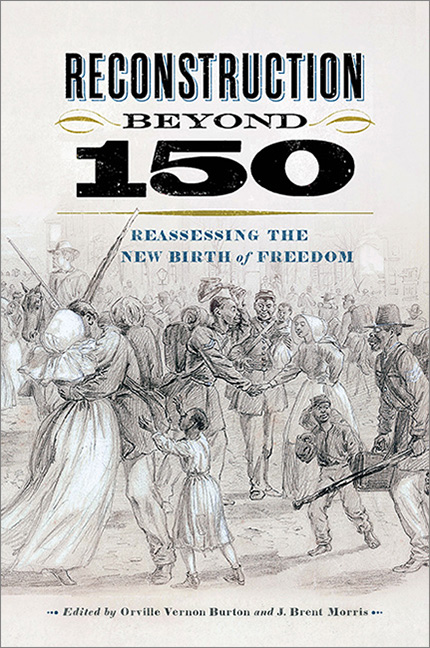
Reconstruction beyond 150
No period of United States history is more important and still less understood than Reconstruction. Now, at the sesquicentennial of the Reconstruction era, Vernon Burton and Brent Morris bring together the best new scholarship on the critical years after the Civil War and before the onset of Jim Crow, synthesizing social, political, economic, and cultural approaches to understanding this crucial period.
Reconstruction was the most progressive period in United States history. Although marred by frequent violence and tragedy, it was a revolutionary era that offered hope, opportunity, and against all odds, a new birth of freedom for all Americans. Even though many of the gains of Reconstruction were rolled back and replaced with a repressive social and legal regime for African Americans, the radical spark was never fully extinguished. Its spirit fanned back into flame with the Civil Rights Movement of the 1950s and 1960s, and its ramifications remain palpable to this day.
- Hilary Green, Davidson College, author of Educational Reconstruction: African American Schools in the Urban SouthThis necessary volume, which features new scholarship reflective of the current trends and directions in Reconstruction studies, encourages new questions and fills a necessary void. It is accessible and comprehensive. All of the essays are fine contributions and work well together.
- William C. Hine, South Carolina State UniversityA valuable contribution to the growing literature on Reconstruction and one which, importantly, sheds a bright light on aspects and issues of Reconstruction that have received little or no attention.
- Stephen Kantrowitz, University of Wisconsin-Madison, author of Citizens of a Stolen Land: A Ho-Chunk History of the Nineteenth-Century United StatesNo period in our history calls to us more urgently than Reconstruction, but no period demands closer or more subtle attention. These essays, exploring topics from high politics to literature and ranging from European capitals to Indian Territory, elegantly capture much of what historians have to offer a nation that is in many ways still locked in its post-Civil War struggles.
Reconstruction Beyond 150 reminds us that historians play an important role in separating fact from fiction and giving voice to all historical actors. We must understand how past events can be misinterpreted using present-day political agendas. If that agenda involves creating false narratives, historians have an ethical duty to call them out as such. We need more bold scholars, like those included in this essay collection, to confront controversial topics and challenge conventional wisdom. Revision not to create political division, but to correct and enhance our retrospective historical vision.- Emerging Civil War
- Journal of the Gilded Age and Progressive EraReconstruction beyond 150 amply demonstrates why the postbellum United States presently comprises one of the most fertile fields of scholarly inquiry. Encompassing fourteen essays…the book’s contents collectively plumb Reconstruction’s nature, impact, legacy, and ongoing relevance. By creatively engaging older and prevailing historiographical issues, they also deftly suggest new ways of thinking and writing about the post-Civil War United States.
Orville Vernon Burton is the Judge Matthew J. Perry Distinguished Chair of History at Clemson University and the author of The Age of Lincoln. J. Brent Morris is Professor of History at Clemson University and the author of Dismal Freedom: A History of the Maroons of the Great Dismal Swamp.
2. Reconstructing Nationalism: Charles Sumner, Human Rights, and American Exceptionalism (Mark Elliott)
3. Oliver P. Morton and the Politics of Reconstruction (A. James Fuller)
4. Building a New Political Order: Reconstruction, Capitalism, and the Contest Over the American State (Nicolas Barreyre)
5. Race, Representation, and Reconstruction: The Origins and Persistence of Black Electoral Power, 1865–1900 (Peter Wallenstein)
6. Lynching in the American Imagination: A Historiographical Reexamination (Mari N. Crabtree)
7. "Magnificent Resources": Reconstruction in Indian Territory (Troy D. Smith)
8. A New Birth of Freedom Abroad (Don H. Doyle)
9. Confederate Reconstructions: Generations of Conflict (David Moltke-Hansen)
10. Reconstruction at the Centennial Exhibition of 1876 (Krista Kinslow)
11. Mark Twain and the Failure of Radical Reconstruction (J. Mills Thornton)
12. Teaching DuBois' Black Reconstruction (Garry Bertholf and Marina Bilbija)
13. Three Historians and a Theologian: Howard Thurman and the Writing of African American History (Peter Eisenstadt)
14. Killing Calvin Crozier: Honor, Myth, and Military Occupation after Appomattox (Lawrence T. McDonnell)

