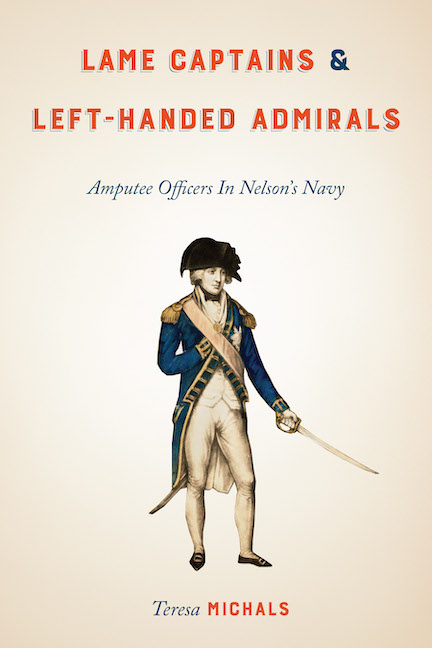
Lame Captains and Left-Handed Admirals
Throughout the Revolutionary and Napoleonic Wars, the Royal Navy had a peculiar problem: it had too many talented and ambitious officers, all competing for a limited number of command positions. Given this surplus, we might expect that a major physical impairment would automatically disqualify an officer from consideration. To the contrary, after the loss of a limb, at least twenty-six such officers reached the rank of commander or higher through continued service. Losing a limb in battle often became a mark of honor, one that a hero and his friends could use to increase his chances of winning further employment at sea.
Lame Captains and Left-Handed Admirals focuses on the lives and careers of four particularly distinguished officers who returned to sea and continued to fight and win battles after losing an arm or a leg: the famous admiral Lord Horatio Nelson, who fought all of his most historically significant battles after he lost his right arm and the sight in one eye, and his lesser-known fellow amputee admirals, Sir Michael Seymour, Sir Watkin Owen Pell, and Sir James Alexander Gordon. Their stories shed invaluable light on the historical effects of physical impairment and this underexamined aspect of maritime history.
Peculiar Bodies: Stories and Histories
- Evan Wilson, U.S. Naval War College, author of A Social History of British Naval Officers, 1775–1815Michals takes an understudied topic in naval history and connects it to a broader historiography of disability, and she does so creatively and effectively.
- Amplitude MagazineIn Lame Captains and Left-Handed Admirals, her forthcoming book, Michals explores how the world’s greatest military force came to rely on dozens of limb-different officers. Far from being marginalized or relegated to desk duty, these figures rose in stature and authority because—not in spite—of limb loss.
- H-WarTeresa Michals’s Lame Captains and Left-Handed Admirals: Amputee Officers in Nelson’s Navy is a masterful work that combines rigorous scholarship with compelling narratives. By examining the lives of amputee officers, Michals provides a fresh perspective on naval history, disability, and personal resilience. Her book challenges traditional narratives of heroism and offers a more inclusive understanding of military service, making it an essential resource for scholars interested in the complexities of human endurance and adaptability. Michals’s work stands as a testament to the indomitable spirit of those who served with courage and determination, despite the physical and societal challenges they faced.
The evidence for behooked pirates in the long eighteenth century [is] virtually nil. The evidence for pervasive maritime limb loss, though, is well beyond dispute; but since it turns out that Captain Hook was an invention, we do not have a strong paradigm for understanding the symbolic weight of amputation for status, masculinity, and even the differences between life on land and at sea. Lame Captains and Left-Handed Admirals is a most welcome and most interesting entry into these studies.- Eighteenth-Century Studies
- H-DisabilityWhen does a man who has lost a limb in military action not have a disability? Apparently, that was the adjudication for naval officers who fought for Great Britain during the Revolutionary and Napoleonic Wars between 1792 and 1815 and lost a limb in combat but returned to active service. In a collective biography of four such officers, Teresa Michals, associate professor of English at George Mason University, has written a revelatory monograph that highlights the mutability of both the experiences and the meanings of disability. There are important lessons here for those who work at the intersections of the new military history and disability history genres.
Teresa Michals is Associate Professor of English at George Mason University.
1. Mostly Ordinary: Amputee Officers in Nelson's Navy
2. Patrons and Followers
3. Looking Like a Hero
4. Love and Friendship
5. Becoming Victorian
Appendix of Amputee Naval Officers

