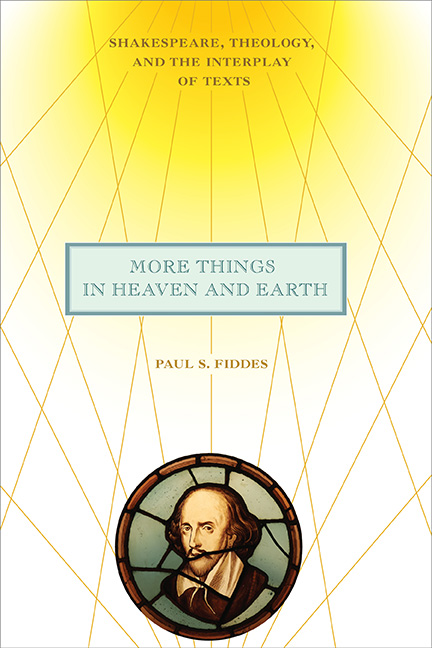
More Things in Heaven and Earth
Shakespeare, Theology, and the Interplay of Texts
Paul S. Fiddes
subjects:
Shakespeare’s plays are filled with religious references and spiritual concerns. His characters—like Hamlet in this book’s title—speak the language of belief. Theology can enable the modern reader to see more clearly the ways in which Shakespeare draws on the Bible, doctrine, and the religious controversies of the long English Reformation. But as Oxford don Paul Fiddes shows in his intertextual approach, the theological thought of our own time can in turn be shaped by the reading of Shakespeare’s texts and the viewing of his plays.
In More Things in Heaven and Earth, Fiddes argues that Hamlet’s famous phrase not only underscores the blurred boundaries between the warring Protestantism and Catholicism of Shakespeare’s time; it is also an appeal for basic spirituality, free from any particular doctrinal scheme. This spirituality is characterized by the belief in prioritizing loving relations over institutions and social organization. And while it also implies a constant awareness of mortality, it seeks a transcendence in which love outlasts even death. In such a spiritual vision, forgiveness is essential, human justice is always imperfect, communal values overcome political supremacy, and one is on a quest to find the story of one’s own life. It is in this context that Fiddes considers not only the texts behind Shakespeare’s plays but also what can be the impact of his plays on the writing of doctrinal texts by theologians today. Fiddes ultimately shows how this more expansive conception of Shakespeare is grounded in the trinitarian relations of God in which all the texts of the world are held and shaped.
- Sarah Beckwith, Duke University, author of Shakespeare and the Grammar of ForgivenessFiddes’s theological breadth and openness are a breath of the freshest of air, bracing, and giving new life. The book is very engagingly written and thoroughly absorbing throughout. It deserves to garner a wide readership among lovers and scholars of Shakespeare and theologians who wish to think with, and through, art, drama, liturgy, poetry.
- Hannibal Hamlin, Ohio State UniversityAn eminent theologian, Paul Fiddes does not just add to our shelves another book on Shakespeare and religion, and he sensibly avoids Shakespeare’s own faith. The startling question he poses is what reading Shakespeare’s plays can do for contemporary theology. Rather a lot, as it turns out. But the depth of Fiddes’s knowledge of literary criticism and theory is also startling. Anyone interested in Shakespeare really will want this book on their shelf.
- Rowan Williams, Magdalene College, Cambridge, author of The Edge of Words: God and the Habits of LanguageA really original study of the religious hinterland of Shakespeare's drama, this book brings together a wealth of literary and theological learning with a deep attentiveness to the text of the plays and an unusual sensitivity to their resonances.
- The Journal of ReligionA richly informed, ambitious book. . . . If religion and literature is experiencing a certain kind of reformulation, away from theology and toward philosophy and cultural criticism, this book is evidence that the parent, how-ever ghostly, is calling from the wings. It may risk churlishness to wish that this extraordinarily learned, exceptionally genial theologian might have more overtly advocated that he can discover more in Shakespeare than philosophy or cultural studies alone can dream.
- Reading Religion[A] significant contribution to Shakespeare studies and to theology…It is not only an exemplary book on how to read literature in light of religion and/or theology, but also on how to develop theology from literature…[A] profoundly worthwhile book that proposes, with much-appreciated accessible prose and clarity of explanation, a method worth applying to other authors.
Paul S. Fiddes is Principal Emeritus and Senior Research Fellow, Regent’s Park College, Professor of Systematic Theology, University of Oxford, and author of several books, including Seeing the World and Knowing God: Hebrew Wisdom and Christian Doctrine in a Late-Modern Context.
Preface
1. Shakespeare’s "More Things" and Religion
2. Shakespeare’s "More Things" and Spirituality
3. Shakespeare’s "More Things" and Theology
4. A Midsummer Night’s Dream and Seeing with the Eyes of Love
5. The Merchant of Venice and the Covenant of Love
6. King Lear and a Journey to Nothingness
7. Hamlet, Hesitation, and Remembrance
8. King Richard II, King John, and the Ambiguities of Power
9. The Winter’s Tale and the Renewal of Life
10. The Tempest and the Risks of Forgiveness
Notes
Bibliography
Index
1. Shakespeare’s "More Things" and Religion
2. Shakespeare’s "More Things" and Spirituality
3. Shakespeare’s "More Things" and Theology
4. A Midsummer Night’s Dream and Seeing with the Eyes of Love
5. The Merchant of Venice and the Covenant of Love
6. King Lear and a Journey to Nothingness
7. Hamlet, Hesitation, and Remembrance
8. King Richard II, King John, and the Ambiguities of Power
9. The Winter’s Tale and the Renewal of Life
10. The Tempest and the Risks of Forgiveness
Notes
Bibliography
Index

