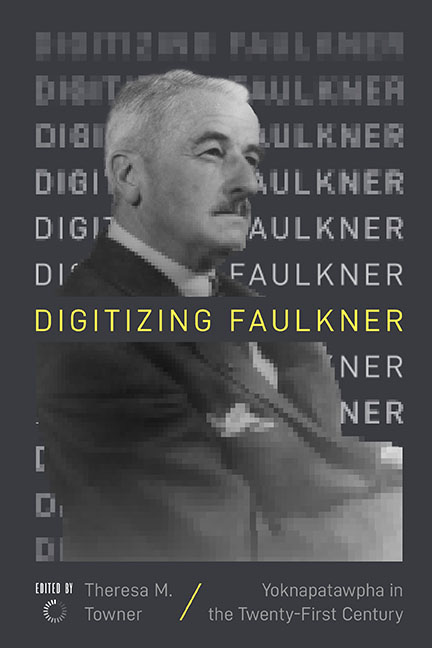
Digitizing Faulkner
Yoknapatawpha in the Twenty-First Century
Edited by Theresa M. Towner
subjects:
For more than eighty years, Faulkner criticism has attempted to "see all Yoknapatawpha," the fictional Mississippi county in which the author set all but four of his novels as well as more than fifty short stories. One of the most ambitious of these attempts is the ongoing Digital Yoknapatawpha, an online project that is encoding the texts set in Faulkner’s mythical county into a complex database with sophisticated front-end visualizations. In Digitizing Faulkner, the contributors to the project share their findings and reflections on what digital research can mean for Faulkner studies and, by example, other bodies of literature.
The essays examine Faulkner’s characters, events, locations, and visualizations, as well as offering more theoretical reflections on digitally mapping specific texts and stories, including the pedagogical implications of this digital approach. Digitizing Faulkner explores how a twenty-first-century research tool intersects with twentieth-century sensibilities, ideologies, behaviors, and material cultures to modify and enhance our understanding of Faulkner’s texts.
Contributors:Johannes Burgers, Ashoka University * John Michael Corrigan, National Chengchi University, Taiwan * Ren Denton, East Georgia State College * Jennie Joiner, Keuka College * Erin Penner, Asbury University * Stephen Railton, University of Virginia * Christopher Rieger, Southeast Missouri State University * Ben Robbins, University of Innsbruck * Melanie Benson Taylor, Dartmouth College * Lorie Watkins, William Carey University
- Wes Hamrick, Digital Humanities Fellow, Greenhouse Studio, University of ConnecticutThis book offers new ways of thinking about the demographics of Faulkner’s fictional Yoknapatawpha, fresh insights into Faulkner’s adaptation of modernist narrative techniques, and a substantial modification of our understanding of the various themes and events in Faulkner’s work—not only in the major novels but throughout his larger oeuvre. The collection’s most unique contribution, however, is in demonstrating how digital humanities projects can both enable and meaningfully inform carefully researched scholarship in traditional formats. Digitizing Faulkner makes and signals significant headway in fulfilling the promise of digital humanities.
No one has defined and demonstrated the potential of digital humanities in navigating literature more than the contributors to Digitizing Faulkner: Yoknapatawpha in the Twenty-First Century. . .This volume provides a comprehensive overview of the Digital Yoknapatawpha Project, commonly referred to as DY, which remains the most technologically sophisticated approach to the works of William Faulkner. . . By narrating the different techniques and thinking processes that went into creating DY, this volume serves as an excellent guide for future digital humanities projects and, by the same token, allows the project’s users to maximize their experience with it.- Mississippi Quarterly
Theresa M. Towner is Ashbel Smith Professor of Literary Studies at the University of Texas at Dallas and author of The Cambridge Introduction to William Faulkner.
Introduction: From Yoknapatawpha to the Virtual World
1. Faulkner from 30,000 Feet: Locations, Characters, and Events in Digital Yoknapatawpha
2. Locations, Ownership, and Information Flow
3. "Around a Hundred and at Least Triplets": Exploring Characters in Digital Yoknapatawpha
4. Events in Digital Yoknapatawpha: Making Faulkner's World Move
5. Visualizing Narrative Modes: The Narratological Mapping of Trauma in Faulkner's Sanctuary
6. Reading the Portable Faulkner through Digital Yoknapatawpha: Recovering the "Problems" and "Difficulties" of "Appendix Compson 1699-1945"
7. Faulkner's Human Hive: Complex Systems in the Hamlet
8. Digital Yaakni Patafa: Plotting Indigenous Space and Race
9. Digital Yoknapatawpha: Pedagogical Practices and the Politics of Digital Humanities in the Twenty-First-Century Classroom
10. Work in Progress
1. Faulkner from 30,000 Feet: Locations, Characters, and Events in Digital Yoknapatawpha
2. Locations, Ownership, and Information Flow
3. "Around a Hundred and at Least Triplets": Exploring Characters in Digital Yoknapatawpha
4. Events in Digital Yoknapatawpha: Making Faulkner's World Move
5. Visualizing Narrative Modes: The Narratological Mapping of Trauma in Faulkner's Sanctuary
6. Reading the Portable Faulkner through Digital Yoknapatawpha: Recovering the "Problems" and "Difficulties" of "Appendix Compson 1699-1945"
7. Faulkner's Human Hive: Complex Systems in the Hamlet
8. Digital Yaakni Patafa: Plotting Indigenous Space and Race
9. Digital Yoknapatawpha: Pedagogical Practices and the Politics of Digital Humanities in the Twenty-First-Century Classroom
10. Work in Progress

