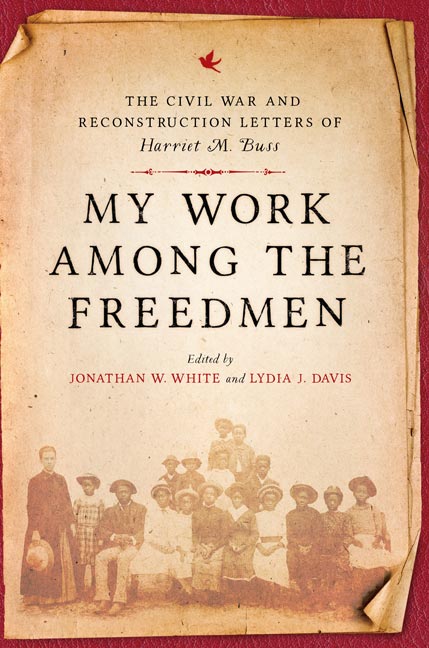
My Work among the Freedmen
The Civil War and Reconstruction Letters of Harriet M. Buss
Harriet M. Buss. Edited by Jonathan W. White and Lydia J. Davis
subjects:
Between 1863 and 1871, Harriet M. Buss of Sterling, Massachusetts, taught former slaves in three different regions of the South, in coastal South Carolina, Norfolk, Virginia, and Raleigh, North Carolina. A white, educated Baptist woman, she initially saw herself as on a mission to the freedpeople of the Confederacy but over time developed a shared mission with her students and devoted herself to training the next generation of Black teachers.
The geographical and chronological reach of her letters is uncommon for a woman in the Civil War era. In each place she worked, she taught in a different type of school and engaged with different types of students, so the subjects she explored in her letters illuminate a remarkably broad history of race and religion in America. Her experiences also offer an inside perspective of the founding of Shaw University, an important historically Black university. Now available to specialists and general readers alike for the first time, her correspondence offers an extensive view of the Civil War and Reconstruction era rarely captured in a single collection.
A Nation Divided: Studies in the Civil War Era
- Michael T. Bernath, University of Miami, author of Confederate Minds: The Struggle for Intellectual Independence in the Civil War SouthBuss’s letters provide a fascinating look into the experiences of Northern women teaching in the Reconstruction South. That she returned again and again, to different locations, teaching at different sorts of schools, and that her letters demonstrate genuine interest in and commitment to the welfare and future of freedpeople makes this collection an invaluable resource for scholars and a pleasure for readers.
- From the foreword by Hilary Green, University of Alabama, author of Educational Reconstruction: African American Schools in the Urban South, 1865–1890Harriet Buss’s work proved more than a novel adventure undertaken by some missionaries. While other white women typically lasted one season, Buss persisted. By bridging race, gender, and region, she helped to lay the foundation for African American public schools and present-day Shaw University. Her letters also reveal the real challenges posed by the Ku Klux Klan and Southern white derailers of Reconstruction as well as the failure of federal leadership. This compelling collection of letters reintroduces readers to Harriet Buss as a significant interlocutor for understanding the motivations, experiences, and achievements of white Northern women who labored on the Southern educational frontier.
- The Civil War MonitorJonathan White and Lydia Davis have a done a fine job introducing readers to Harriet Buss and her world. The editorial work is excellent, both in the introductions to each section of letters and in the annotations. Unlike many edited collections, this one has a thorough subject index that will assist a wide range of researchers. At the same time, My Work Among the Freedmen is simply worth reading to meet Harriet Buss and her students.
- Civil War TimesThe good Harriet Buss accomplished permeates her amazing letters
A valuable contribution to the study of the Civil War era. Harriett Buss’s experiences in Port Royal brought her into contact with such familiar figures as Harriet Tubman, Robert Smalls, and James Montgomery. These associations, paired with the editor’s annotations, make the Civil War letters in this volume an excellent teaching resource, while the Reconstruction letters provide a comprehensive look at how day-to-day education functioned after the war. Social historians, as well as historians of race and education, will doubtless find plenty of material to work with here. Scholars may be especially interested in the complex interplay between personal progress and prejudice, an interplay that shaped the relationship between Buss and her students.- American Nineteenth Century History
Buss’s letters provide incredible access to the life and thoughts of a northern white female teacher during the Civil War era. Readers of her letters will find a wealth of information on a host of topics related to race relations, nineteenth-century politics, gender, and the reality of living in a wartime and postwar society. They will also encounter someone who is very human and whose personality shines through by discussing rather normal, yet fascinating, things, like her obsession with food. She also comes across as someone who embraced hopefulness for the future, as evidenced by her dedication to teaching Black Americans. Moreover, Harriet Buss provides readers and researchers alike with a rich collection of letters that help us better understand this important moment in our history.- The Virginia Magazine of History and Biography
Jonathan W. White is Associate Professor of American Studies at Christopher Newport University and author and editor of twelve books, including Midnight in America: Darkness, Sleep, and Dreams during the Civil War. Lydia J. Davis is a history educator at the Mariners' Museum in Newport News, Virginia..
List of Illustrations
Foreword by Hilary Green
Acknowledgments
Introduction
Note on Method
Abbreviations
1. Beaufort, South Carolina, 1863
2. Hilton Head, South Carolina, 1863-1864
3. Massachusetts, 1864-1868
4. Norfolk, Virginia, 1868-1869
5. Raleigh, North Carolina, 1869-1870
6. Raleigh, North Carolina, 1870-1871
Epilogue
Notes
Index
Foreword by Hilary Green
Acknowledgments
Introduction
Note on Method
Abbreviations
1. Beaufort, South Carolina, 1863
2. Hilton Head, South Carolina, 1863-1864
3. Massachusetts, 1864-1868
4. Norfolk, Virginia, 1868-1869
5. Raleigh, North Carolina, 1869-1870
6. Raleigh, North Carolina, 1870-1871
Epilogue
Notes
Index

