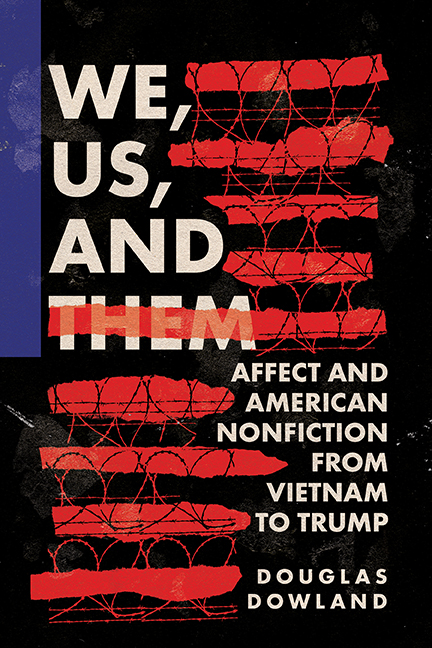
We, Us, and Them
Affect and American Nonfiction from Vietnam to Trump
Douglas Dowland
subjects:
When Americans describe their compatriots, who exactly are they talking about? This is the urgent question that Douglas Dowland asks in We, Us, and Them. In search of answers, he turns to narratives of American nationhood written since the Vietnam War—stories in which the ostensibly strong state of the Union has been turned increasingly into an America of us versus them. Dowland explores how a range of writers across the political spectrum, including Hunter S. Thompson, James Baldwin, and J. D. Vance, articulate a particular vision of America with such strong conviction that they undermine the unity of the country they claim to extol. We, Us, and Them pinpoints instances in which criticism leads to cynicism, rage leads to apathy, and a broad vision narrows in our present moment.
“Dowland makes a convincing case for the importance of thinking about affect and nonfiction as a way not only to understand the political moment of the present but also to trace some of the ways this present has developed and come into being.”- Sean Austin Grattan
The language of nationalism tends to be reductive, shrill, simplistic, otherizing, and suspicious. But why? In We, Us, and Them, Douglas Dowland offers an answer by examining the rhetorical tropes that structure and impoverish nationalist discourse, often to the detriment of democratic culture and politics. By concentrating on nonfiction in particular, this timely book shows how reality itself all too frequently becomes conscripted for narrow and exclusionary ends.- Russ Castronovo, University of Wisconsin-Madison, author of American Insecurity and the Origins of Vulnerability
Douglas Dowland is Associate Professor of English at Ohio Northern University and the author of Weak Nationalisms: Affect and Nonfiction in Postwar America.
Acknowledgments
Introduction: The Problem of Strong Nationalism
1. Hawkishness: John Steinbeck’s Vietnam Journalism
2. Bile: Hunter S. Thompson’s America
3. Futility: James Baldwin’s The Evidence of Things Not Seen
4. Resentment: J. D. Vance’s Hillbilly Elegy
5. Depression: David Sedaris, Donald Trump, and the Divided Nation
Conclusion: The Nation Needs Reading
Notes
Bibliography
Index
Introduction: The Problem of Strong Nationalism
1. Hawkishness: John Steinbeck’s Vietnam Journalism
2. Bile: Hunter S. Thompson’s America
3. Futility: James Baldwin’s The Evidence of Things Not Seen
4. Resentment: J. D. Vance’s Hillbilly Elegy
5. Depression: David Sedaris, Donald Trump, and the Divided Nation
Conclusion: The Nation Needs Reading
Notes
Bibliography
Index

