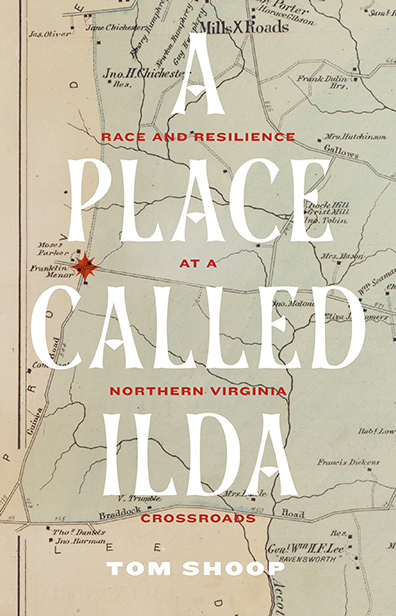
A Place Called Ilda
The compelling history of a racially integrated, and now forgotten, community in northern Virginia
Established by two Black entrepreneurs and their families, who provided the economic engine for its initial success, the village of Ilda flourished as a racially integrated community before the Jim Crow era. More than simply a history of a racially and socially pioneering community, this remarkable book tells a broader story, recounting the Black experience in Fairfax County over generations and shedding new light on the racial, economic, political, and bureaucratic factors that drove the development of Northern Virginia and the nation as a whole. Weaving together accounts of horse thievery, attempted murder, savage beatings, hate crimes, and a long-forgotten cemetery, this gripping and often moving narrative provides a rich and unusually detailed record of the rise, decline, and rediscovery of a crossroads whose secrets and mysteries depict an America that might have been, and might still be.
Winner of the Nan Netherton Prize from the Fairfax County History Commission
- Virginia Magazine of History and BiographyThis microhistory demonstrates the ways in which a place as small as a crossroads can tell a compelling history, not only about the location itself, but also the broader forces operating in the United States from the colonial period to the present. For Shoop, this history includes slavery and freedom, interracial coalitions and segregationist practices, the expansion of the federal government and suburbanization, and cemeteries and memorialization. . . . A great way to learn about the complex history of Virginia's racialized landscape. This text is particularly important to our growing understanding of Northern Virginia, which, despite its economic importance and population growth, is perennially overlooked in historical stufdies on the state.
In clear, engaging prose, A Place Called Ilda plots out the promise and tribulations that have centered around a small African American cemetery that anchored a crossroads community from the mid-nineteenth century on. Shoop finds the resonance of national historical forces in an overlooked corner of today’s nondescript suburbs.- Ryan K. Smith, Virginia Commonwealth University, author of Death and Rebirth in a Southern City: Richmond’s Historic Cemeteries
A Place Called Ilda is one of those books that you might feel compelled to finish in one marathon sitting. Author Tom Shoop weaves together a gripping narrative that brings to life a place from which a host of quintessentially American stories are told. For those of us who live steps from what was once a thriving Reconstruction-era integrated community lost to the forces of Jim Crow, it's a reminder of the fragility and uneven nature of progress. In this poignant tale, Shoop captures the essence of resilience and community, leaving readers with a lasting appreciation for the power of history to shape our present.- Braddock Supervisor James Walkinshaw, James Walkinshaw, Fairfax County Board of Supervisors
Shoop has written a public history of the perils of living as freedpeople after the Civil War and of African American perseverance in founding communities, as wider Fairfax County upended their institutions, removed their cemeteries, and revoked the land from their descendants. . . upon reading A Place Called Ilda localities should face the crossroads of public memory by following the ultimate example of Fairfax County, as it changed the way it preserves and interprets history to honor the contributions of African Americans.- Journal of Southern History
1. Destruction
2. Reconstruction
3. Transition
4. Segregation
5. Determination
6. Revelation
7. Preservation
8. Redemption
Acknowledgments
Notes
Bibliography
Index

