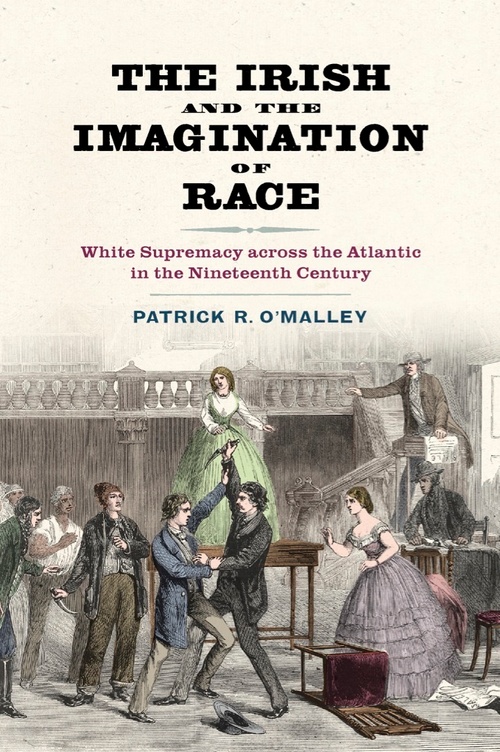
The Irish and the Imagination of Race
White Supremacy across the Atlantic in the Nineteenth Century
Patrick R. O'Malley
subjects:
Honorable Mention—Lawrence J. McCaffrey Prize for Books on Irish-America
This book analyzes the role of Irishness in nineteenth-century constructions of race and racialization, both in the British Isles and in the United States. Focusing on the years immediately preceding the American Civil War, Patrick O’Malley interrogates the bardic verse epic, the gothic tale, the realist novel, the stage melodrama, and the political polemic to ask how many mid-nineteenth-century Irish nationalist writers with liberationist politics declined to oppose race-based chattel enslavement in the United States and the structures of white supremacy that underpinned and ultimately outlived it. Many of the writers whose work O’Malley examines drew specifically upon the image of Black suffering to generate support for their arguments for Irish political enfranchisement; yet in doing so, they frequently misrepresented the fundamental differences between Irish and Black experience under the regimes of white supremacy, which has had profound consequences.
- Amy E. Martin, Mount Holyoke College, author of Alter-nations: Nationalisms, Terror, and the State in Nineteenth-Century Britain and IrelandAn urgently needed and transformative intervention into the fields of Irish Studies, Victorian Studies, and American Studies. O’Malley provides a brilliant account of the relationship between Irish nationalism, Irish-American literary culture, and the consolidation of white supremacy in the US and in Britain. The stakes of this text are not only aesthetic but reveal the ways in which form and genre are key to understanding much larger political formations and forces. By the end of this rigorously argued book, the racial politics of Irish nationalism cannot be understood in the same way.
A stimulating and valuable book in which O'Malley blends moments of transformation in Ireland and the United States with transformations in literary genre. The treatment of genre in this manner, as a way of knowing and as a way of generating knowledge to shape discourse and practice, particularly in relation to understandings and manifestations of race in Irish America, has important implications not only for Irish America but also for American Studies, for Historical Studies and for Literature Studies more broadly.- American Conference for Irish Studies
How does imagination of race manifest in genres of writing? What body of evidence could help answer such a question, and what methods would be adequate to apprehend it? Weaving the development of race science together with Victorian studies’ continuing failure to confront the inextricability of white supremacy with genre, Patrick O’Malley’s deeply researched account begins to show how several emblematic genres shaped the contours of Irish whiteness. Even more importantly, its head-spinning juxtapositions demonstrate how concretely the stories we tell about race are linked to the stories we tell about genre. The gothic, the bardic epic, the stage melodrama, the political polemic, the sentimental novel, and the national tale become exemplary in this transatlantic study that takes seriously the ways that ideas of race and genre were transmitted, circulated, and became normative.- North American Victorian Studies Association Subsequent Book Prize Honorable Mention
Patrick R. O’Malley is Professor of English at Georgetown University and the author of Liffey and Lethe: Paramnesiac History in Nineteenth-Century Anglo-Ireland.

